Law Firm Website Design Best Practices to Attract Clients
Your phone hasn’t rung in two hours, and your inbox is empty. You’ve invested in a sleek logo and a downtown office, yet your website still treats visitors like suspects instead of clients. If this feels familiar, you’re not alone. Many USA law firms struggle to turn digital traffic into signed retainers because their sites were built to impress peers rather than convert prospects. In this guide, we’ll break down law firm website design principles that build trust, satisfy search engines, and move prospects from research to intake. You’ll walk away with a practical checklist you can share with your marketing team or agency today. Small improvements can yield immediate shifts in inquiry volume.
What Makes a Good Law Firm Website Design?
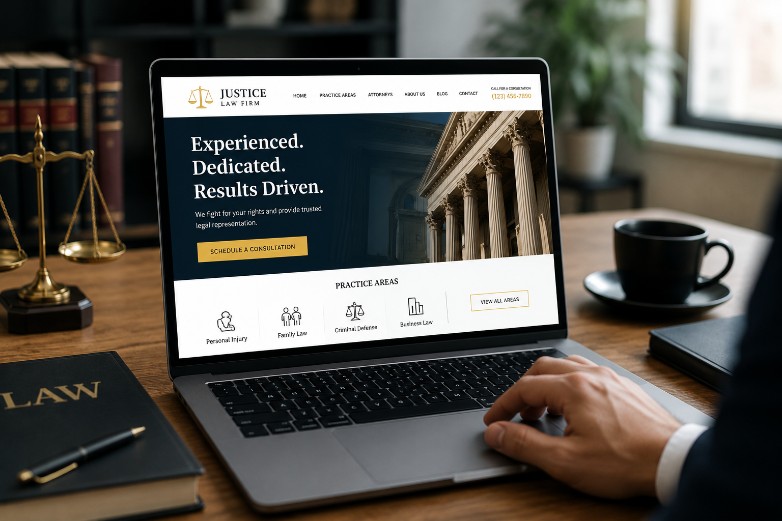
Effective law firm website design is not about winning beauty contests. It is about credibility at a glance. When a prospective client lands on your site after a late-night Google search, they are asking one question: “Can I trust this firm with my problem?” Generic templates, stock imagery of gavels and scales, and walls of dense text signal that you may be behind the times—or worse, hiding something.
Attorney website design that converts shares three traits. First, it communicates specialization immediately. A homepage that tries to be everything to everyone ends up being nothing to anyone. Second, it uses clean navigation and readable typography to respect the visitor’s time. Third, it offers clear pathways to action, whether that is a phone call, a form, or a scheduling link.
Design also serves a dual audience. Prospects evaluate your empathy and competence, while referral sources—other attorneys, accountants, and professionals—vet your credibility before sending business your way. A polished site reassures both groups. According to industry guidance from Clio, top-performing legal sites balance professional aesthetics with intuitive user paths that mirror how real people seek help.
Trust signaling happens in milliseconds. High-quality photography of your actual team, consistent branding, and accessible contact information reduce perceived risk. When design signals competence, inquiries rise. That is why firms looking for a strategic partner often turn to specialists like Grow Law to align visual identity with intake goals. The connection between professional presentation and signed retainers is not speculative; it is measurable in form fills and call volume.
Nielsen Norman Group research emphasizes that users leave sites when they cannot find expected information quickly. For law firms, this means burying practice areas behind vague labels like “What We Do” costs you leads. Effective attorney website design places the client’s pain points front and center, using language they actually use, not Latin abbreviations or insider jargon. If your site reads like a treatise, prospects will bounce before they ever reach your contact page.
Trinity Partners notes that solo and small firm sites often outperform larger competitors when they lead with local brand identity and specific outcomes rather than pedigree alone. Your credentials matter, but visitors want to know whether you have solved problems like theirs. A good design foregrounds that proof without overwhelming the reader. It also loads fast, works flawlessly on smartphones, and respects accessibility standards—signals that tell clients you will handle details carefully. When every pixel reinforces reliability, your website becomes your most patient, hardworking business development tool.
Essential Architecture and Pages for Legal Websites
USA law firms can no longer treat a website like a digital brochure. Under modern law firm website design best practices, your site is an intake engine. That engine needs specific pages to function, and missing any one of them creates a leak in your client acquisition funnel.
Every legal site requires five foundational page types:
- A homepage that states your value proposition within three seconds of arrival
- Practice area or service pages that match specific search intent and local jurisdiction
- Attorney profiles that humanize your team with real photography and substantive bios
- A contact page with multiple intake options—phone, form, and scheduling
- A blog or resource section that demonstrates ongoing expertise and answers pre-client questions
Clio’s review of top firm websites confirms this baseline architecture consistently appears among high-performing examples.
But the firms that separate themselves from the competition add what we call differentiator pages. These include process explanations that walk prospects through what happens after they call, fee expectation pages that address cost anxiety upfront, and FAQ sections that answer repetitive intake questions before a consultation is ever booked. MyCase research on legal marketing strategies shows that transparency around timeline and pricing significantly reduces sales friction for potential clients who are comparison shopping between three or four firms.
Think about the last time you hired a professional. You probably wanted to know how long it would take, what it would cost, and who exactly would handle your matter. Your prospects are no different. A “What to Expect” page for criminal defense, estate planning, or personal injury can preempt objections and filter out unqualified leads. Trinity Partners emphasizes that solo practitioners especially benefit from clearly delineated service pages because they establish scope and prevent scope-creep before the first conversation.
Blog content supports long-term legal marketing strategies by capturing research-phase traffic. A person researching “How long does probate take in Texas?” may not need a lawyer today, but when they do in six months, your firm will be the one that answered their question honestly. Architecture is not merely about having the right pages; it is about arranging them so a frightened, confused, or angry visitor can find answers without clicking more than twice. Removing ambiguity removes hesitation—the force that sends prospects to the next tab.
Mobile-First UX and Legal Website SEO
Google has shifted to mobile-first indexing for the entire web, and legal website SEO strategy must adapt. If your firm’s site still treats mobile as an afterthought, you are not just frustrating users; you are risking invisibility in search results. For digital marketing for lawyers, this means performance and accessibility are no longer optional technical concerns. They are baseline requirements for appearing before potential clients at the moment they need counsel.
Security is equally non-negotiable. Google announced HTTPS as a ranking signal in 2014, and modern browsers now flag non-secure sites with alarming warnings. A prospect who sees “Not Secure” next to your URL will not stick around to learn about your verdict record. HTTPS encrypts data transmitted through intake forms and chat widgets, protecting both your firm and your clients.
Many attorneys unknowingly sabotage their own visibility through robots meta tag errors. If your mobile theme accidentally places a noindex tag on practice area pages while your desktop version leaves them open, Google may fail to index the content entirely. This is especially common when law firms use separate mobile themes or AMP implementations that lack proper configuration. Regular technical audits are essential because small deployment errors create large revenue losses. Treat mobile parity as a compliance exercise: what exists on desktop must exist on smartphone, period.
Mobile-First Indexing Requirements
Google uses a smartphone agent to crawl and index your site. Your mobile version must contain the same content, structured data, and metadata as your desktop version. Google Search Central warns that content parity is critical; if your mobile site hides paragraphs, shrinks navigation into an unusable menu, or uses conflicting robots meta tags, you risk incomplete indexing. Audit your templates quarterly. Verify that practice pages, attorney bios, and blog posts render fully on small screens without truncation.
Core Web Vitals for Legal Sites
Core Web Vitals measure how real users experience your pages. Largest Contentful Paint (LCP) tracks loading speed; Interaction to Next Paint (INP) measures responsiveness; Cumulative Layout Shift (CLS) counts visual stability. Poor scores do not guarantee ranking drops, but slow loads kill conversions. If your intake form jumps down the screen while a prospect tries to click submit, you lose the lead. Google Search Central documents these metrics as tools to protect user experience. Fix performance to protect revenue, not just rankings.
Structured Data and Search Snippet Optimization
Structured data is behind-the-scenes markup that tells Google what your content means, not just what it says. For legal website SEO, this distinction matters enormously. When you mark up attorney profiles, client reviews, and practice area descriptions with schema, you help Google categorize your firm correctly. This can enable supported search features like rich results, though it is important to understand what schema cannot do.
Many attorneys assume structured data guarantees higher rankings or flashy search result boxes. It does not. Google Search Central explains that structured data helps Google understand page content and enables supported features, but rich results are never guaranteed. Think of schema as a translation layer: it makes your content digestible for machines without changing the substance of what you offer. Real law firm lead generation still depends on authoritative content, local relevance, and trustworthy presentation.
Your title links and meta descriptions influence how your pages appear in search, but Google reserves the right to rewrite them algorithmically. That means your snippet engineering must focus on accuracy and enticement rather than rigid control. Strong on-page text remains your most reliable snippet source because Google frequently pulls descriptions directly from body content when it deems the meta description irrelevant to the user’s specific query. Write for humans first, then optimize for machines.
Structured Data Implementation for Law Firms
Use schema markup for local business information, legal service types, and attorney profiles. Validate your implementation with Google’s Rich Results Test. Remember that structured data helps Google understand content and can enable supported search features, but it cannot promise rankings or guaranteed rich results. Avoid spammy markup tactics; incorrect implementation can trigger manual actions. Keep your markup accurate, minimal, and tightly aligned with visible page content rather than hidden stuffing.
Snippet Engineering for Practice Pages
Craft unique titles under 60 characters and meta descriptions under 160 characters for every practice page. Front-load target phrases naturally. However, Google’s snippet guidance states that the search engine may generate alternative summaries from on-page text if they better match the query. Therefore, your first paragraph on every practice page should function as a compelling, factual summary of your services. Strong on-page text is non-negotiable because algorithms, not editors, now curate much of what searchers see.
Client Acquisition and Conversion Design
Not every legal service triggers the same buying behavior. A person facing DUI charges at midnight needs a phone number and immediate reassurance. A business owner evaluating estate planning attorneys needs detailed process explanations and credibility proof before they invite you into their financial life. Smart client acquisition for law firms recognizes this urgency gap and designs conversion paths accordingly.
High-urgency practice areas demand prominent click-to-call buttons, live chat staffed by humans, and short intake forms placed above the fold. Research-heavy services benefit from downloadable guides, video explanations, and calendar scheduling that respects a longer decision cycle. In both cases, friction is the enemy. Every extra field in your form or extra click to reach a human reduces completion rates and damages law firm lead generation.
Trust signals must appear early and often. These include bar admissions, years in practice, case result summaries where ethically permitted, and security badges. But the most powerful signal is clarity. Tell prospects exactly what happens when they submit a form. Will you call within two hours? Will they receive a confirmation email? Predictability converts better than aggressiveness. When visitors know the next step, they take it. Trinity Partners notes that conversion-focused design for legal sites often outperforms generic business templates because legal consumers carry higher anxiety.
Trust Signals and Testimonial Governance
The FTC’s updated Endorsement Guides require that endorsements reflect typical results unless you clearly and conspicuously disclose what consumers can generally expect. Additionally, the FTC’s .com Disclosures guidance, first published in 2013, mandates that disclaimers be clear, conspicuous, and placed near the claim—not buried in footer text. ABA Model Rule 7.1 further prohibits misleading communications, so review all endorsements with compliance counsel.
Intake Optimization and UX Patterns
For high-urgency services like personal injury or criminal defense, place a click-to-call button and a short form in the upper portion of every page. Use contrasting colors. For research-heavy areas like estate planning or corporate formation, prioritize educational content with soft CTAs such as “Download our checklist” or “Schedule a consultation.” Remove unnecessary fields. Ask for name, contact, and case type only. You can gather details during the initial call. The goal is to start a conversation, not interrogate a visitor.
ADA Compliance and Ethics Standards
Accessibility is not a niche concern for law firms; it is a professional obligation. Under the ADA, websites are increasingly treated as places of public accommodation. This means your digital presence must be usable by people with visual, auditory, motor, and cognitive disabilities. Implementing compliant attorney website design protects your firm from litigation risk while expanding your reachable market to include the millions of Americans living with disabilities.
WCAG 2.2, published by W3C in October 2023, provides the most current technical guidance for web accessibility. It addresses contrast ratios, keyboard navigation, form labels, and touch target sizing. While the Department of Justice does not have a single regulation explicitly mandating WCAG for all private entities, ADA.gov guidance points to WCAG and Section 508 standards as helpful benchmarks. Following WCAG 2.2 keeps your firm on defensible ground and demonstrates the thoroughness clients expect.
Beyond technical standards, your copy must pass ethical scrutiny. ABA Model Rule 7.1 prohibits false or misleading communications about your services. Superlatives like “best,” guaranteed outcomes, and unsubstantiated statistics expose you to bar complaints. Ethics-proofing your content is one of the most overlooked law firm marketing tips, yet it is foundational to sustainable growth and professional integrity.
WCAG 2.2 and ADA Standards
The Department of Justice recognizes that ADA Title II and III obligations apply to web content, but ADA.gov guidance notes that DOJ does not have a regulation setting out detailed standards for all entities. Instead, WCAG 2.2 offers helpful technical guidance. Focus on perceivable content, operable navigation, understandable language, and robust compatibility. Simple steps like alt text for images, logical heading structures, and resizable text solve the majority of accessibility barriers without requiring a full rebuild.
Ethics-Proof Copy Framework
Create a review workflow where every homepage and practice-page claim is tested against ABA Model Rule 7.1. The Rule states that a lawyer shall not make a false or misleading communication, including one that omits necessary facts. Document the substantiation for any results-based language. If you cannot prove it, remove it. Assign a partner or compliance officer to audit the site quarterly, just as you would review trust account records.
Implementation and Digital Marketing Success
You now have a blueprint. The next step is execution. For most USA law firms, platform choice comes down to flexibility versus speed. WordPress offers deep customization, robust SEO plugin ecosystems, and ownership portability, while hosted builders provide faster deployment with less maintenance overhead. MyCase notes that many firms thrive on WordPress when they have ongoing technical support, whereas solo practitioners sometimes prefer managed solutions that include hosting and security updates. Consider your internal resources honestly. A beautiful site collects dust if no one updates it.
No matter the platform, validate your work with real users. Nielsen Norman Group recommends iterative usability testing with five participants per round. Test three distinct tasks: finding a practice area, evaluating attorney fit, and submitting an inquiry. Observe where users hesitate, where they backtrack, and where they abandon the task entirely. Fix the obvious problems, then test again. Three rounds of five users will uncover more usability issues than one bloated study ever could.
Establish an update cadence. Refresh practice area pages quarterly to reflect statutory changes and local case law. Publish blog content at least twice monthly. Audit technical SEO twice yearly. And if your team lacks bandwidth, partner with a specialized agency that understands law firm website design and the unique compliance pressures attorneys face. Knowing how to attract legal clients online is not a one-time project; it is a continuous improvement cycle.
Tracking matters desperately. Set up conversion goals that match your intake milestones: form submission, consultation booked, and retainer signed. Tag every campaign so you can attribute signed cases to specific blog posts, paid ads, or referral directories. Digital marketing for lawyers fails when firms optimize for traffic instead of retained cases. Measure cost per signed case by channel, not just cost per lead. When you know which blog post, which ad, and which referrer actually produces revenue, you can invest with confidence.
Your website is your hardest-working partner. It answers calls at midnight, qualifies prospects while you are in court, and validates your credibility before you ever shake a hand. To make it work harder, remember three principles. First, design for trust and clarity, not vanity. Second, build the architecture and content that reduces friction for anxious legal consumers. Third, validate everything through accessibility, ethics, and real user feedback.
Start with one improvement this week. Audit your mobile homepage. Add a fee transparency page. Or run a five-user test. Small, deliberate steps compound into measurable growth. Your next client is already searching. Make sure your firm is the one they trust.