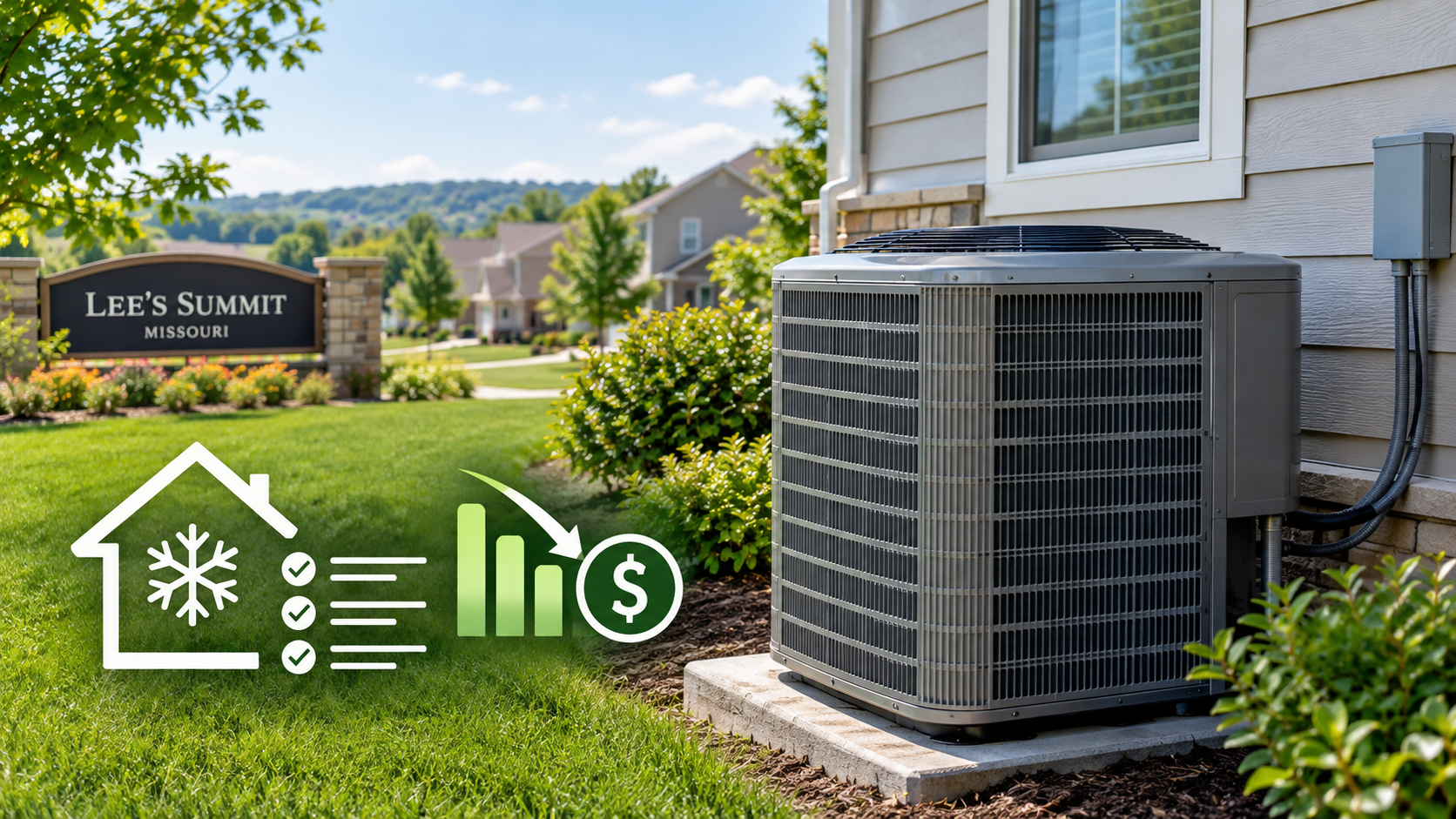
Replacing a central air conditioning system is one of the single largest investments you will make in your home. For homeowners in Lee’s Summit, Missouri, staying comfortable during the summer is not just a matter of convenience—it is a necessity. Jackson and Cass counties experience prolonged periods of high heat paired with intense humidity. When outdoor temperatures climb into the mid-90s with relative humidity topping 70%, your cooling system works under extreme thermal stress.
When facing an aging unit or skyrocketing electric bills, many homeowners naturally assume that buying a larger system will cool the house faster and handle heat waves more effectively. In the field of residential HVAC engineering, however, “bigger” is rarely better.
Installing an oversized air conditioner can be just as problematic as installing an undersized one. An improperly sized AC system degrades indoor air quality, shortens equipment lifespan, creates muggy indoor conditions, and drives up monthly utility costs.
This comprehensive guide breaks down the science of residential load calculation, explains why rule-of-thumb square footage estimates fail, explores the financial impact of AC sizing, and walks you through choosing the optimal cooling system for your Lee’s Summit home.
The Hidden Costs of an Improperly Sized Air Conditioner
When an air conditioner is installed without a precise heat load calculation, the system inevitably falls into one of two categories: oversized or undersized. Both scenarios result in significant financial losses and poor indoor comfort.
Scenario A: The Oversized AC Unit (Short-Cycling)
An oversized AC unit possesses too much cooling capacity (BTUs per hour) for the thermal envelope of the home. While it cools the indoor air temperature rapidly, it triggers a destructive operational pattern known as short-cycling.
- Inadequate Dehumidification: Air conditioners perform two distinct jobs: sensible cooling (lowering dry-bulb air temperature) and latent cooling (removing moisture from the air). Dehumidification requires continuous airflow across cold evaporator coils for sustained periods (at least 10 to 15 minutes per cycle). An oversized unit satisfies the thermostat in 5 to 7 minutes and shuts down before removing humidity. The result is a cold, clammy house with high relative humidity, creating ideal conditions for mold growth.
- Electrical Current Spikes: Electric motors draw up to 3 to 5 times more electrical current during startup (inrush current) than during steady-state operation. Because an oversized unit starts and stops 4 to 6 times per hour, power consumption surges dramatically, accelerating electrical utility costs.
- Premature Mechanical Wear: Frequent cycling causes rapid mechanical wear on contactors, run capacitors, and compressor bearings, leading to unexpected system breakdowns.
Scenario B: The Undersized AC Unit (Continuous Run & Strain)
An undersized air conditioner lacks the cooling tonnage needed to overcome the heat entering your home during peak summer afternoons.
- Non-Stop Operation: During 90°F+ heatwaves in Missouri, an undersized unit runs continuously for hours without reaching the thermostat setpoint.
- Elevated Energy Bills: While continuous operation at steady state avoids startup power surges, running non-stop at 100% capacity for 14 hours straight consumes massive amounts of kilowatt-hours (kWh).
- Thermal Discomfort: Second-story bedrooms and rooms with south-facing windows become uncomfortably warm, regardless of how low you set your thermostat.
Comparison of Sizing Impact on System Performance
| Performance Metric | Undersized AC System | Properly Sized AC System | Oversized AC System |
| Cooling Cycle Length | Continuous (30+ minutes) | Balanced (15–20 minutes) | Short-cycling (3–8 minutes) |
| Indoor Humidity Removal | Moderate | Optimal (40%–50% RH) | Poor (60%+ Clammy) |
| Energy Consumption | High (Continuous Draw) | Lowest (Optimal Efficiency) | High (Startup Spikes) |
| Compressor Lifespan | Reduced (Thermal Fatigue) | Maximized (15–20 Years) | Reduced (Frequent Cycling) |
| Temperature Consistency | Hot Spots in Upper Floors | Even Comfort Across Zones | Cold Flashes / Rapid Swings |
Why “Square Footage Rules of Thumb” Fail in Lee’s Summit
Historically, some contractors relied on crude estimates—such as “1 ton of cooling capacity per 500 square feet.” Using this formula for a 2,500-square-foot two-story home in Lee’s Summit would suggest a 5-ton AC system. In modern residential construction, this approach is inaccurate and often leads to severe oversizing.
According to technical resources from the U.S. Department of Energy, square footage is only one of over a dozen variables required to determine proper cooling capacity.
Two homes with identical 2,200-square-foot floor plans in the same neighborhood can have vastly different cooling requirements based on structural and environmental factors:
- Older Construction Profile (e.g., Built 1985): Features R-13 wall insulation, single-pane clear glass windows, unsealed flex ductwork, and higher air leakage rates. This setup typically requires a larger cooling capacity (around 3.5 Tons / 42,000 BTU) to offset thermal loss.
- Modern High-Efficiency Construction (e.g., Built 2020): Features R-21 wall insulation with spray foam, double-pane Low-E argon windows, fully sealed R-8 ductwork, and a tight building envelope. This profile requires significantly less capacity (around 2.5 Tons / 30,000 BTU) for the exact same square footage.
Relying solely on floor space ignores how modern building materials, insulation levels, and solar orientation affect heat transfer.
The Science of AC Sizing: ACCA Manual J Load Calculations
Professional HVAC engineers and certified contractors do not guess equipment capacity. Instead, they perform a comprehensive building load analysis known as an ACCA Manual J Calculation. Developed by the Air Conditioning Contractors of America, Manual J is the national standard for residential load calculation.
Key Variables Evaluated in a Manual J Calculation
1. Outdoor Design Temperatures for Lee’s Summit
Manual J calculations use historical climate data established by ASHRAE (American Society of Heating, Refrigerating and Air-Conditioning Engineers). For the Kansas City metropolitan area, the summer 1% outdoor design temperature is approximately 92°F to 94°F dry-bulb, with an indoor design target of 75°F at 50% relative humidity. Sizing an AC to maintain 65°F during a 105°F heatwave results in an oversized system for 98% of the summer season.
2. Building Envelope and Thermal Resistance (R-Values)
The technician measures insulation depth in the attic, walls, crawlspace, or basement. Higher R-values slow conductive heat transfer through building assemblies.
3. Window Area, Orientation, and SHGC
Windows account for a massive portion of summer radiant heat gain. Manual J evaluates:
- Solar Heat Gain Coefficient (SHGC): How much solar radiation passes through the glass.
- Directional Orientation: West- and south-facing windows absorb significantly more thermal energy during hot afternoons than north-facing glass.
- External Shading: Overhangs, mature trees, and patio covers that block direct sunlight.
4. Air Infiltration and Ductwork Losses
Conditioned air lost through leaky ductwork in an unconditioned attic reduces net cooling capacity. The assessment evaluates envelope tightness (measured via blower door testing) and duct leakage rates.
5. Internal Heat Gain
Appliances, LED versus incandescent lighting, kitchen equipment, and the number of permanent human occupants contribute sensible heat load to the interior space.
How Air Conditioner Capacity Is Measured (BTUs and Tonnage)
Air conditioning capacity is rated in BTUs (British Thermal Units) and Tonnage.
- 1 BTU: The amount of heat energy required to raise or lower the temperature of 1 pound of water by 1°F.
- 1 Ton of Cooling: Equal to 12,000 BTUs per hour. This terminology stems from the ice-making era, representing the rate of heat extraction needed to melt 1 short ton (2,000 lbs) of ice over a 24-hour period.
Standard Residential AC Tonnage Chart
| System Capacity (Tons) | Cooling Output (BTU/hr) | Typical Application Range (Subject to Manual J) |
| 1.5 Tons | 18,000 BTU/hr | Small Condos / Energy-Efficient Additions (800–1,100 sq ft) |
| 2.0 Tons | 24,000 BTU/hr | Small Single-Story Homes / Townhomes (1,100–1,500 sq ft) |
| 2.5 Tons | 30,000 BTU/hr | Mid-Size Single-Story Homes (1,500–1,900 sq ft) |
| 3.0 Tons | 36,000 BTU/hr | Standard 2-Story / Split-Level Homes (1,900–2,400 sq ft) |
| 3.5 Tons | 42,000 BTU/hr | Large 2-Story Homes (2,400–2,900 sq ft) |
| 4.0 Tons | 48,000 BTU/hr | Sprawling Single-Story / Large Homes (2,900–3,500 sq ft) |
| 5.0 Tons | 60,000 BTU/hr | Executive Estates / High-Square-Footage Structures (3,500+ sq ft) |
Note: Residential split-system central AC units are generally manufactured in 0.5-ton increments, ranging from 1.5 tons up to 5.0 tons.
If your home’s load calculation indicates a requirement of 32,000 BTU/hr, a professional installer will evaluate duct capacity and static pressure before recommending whether a 2.5-ton (30,000 BTU) or 3.0-ton (36,000 BTU) unit with staging technology is the appropriate choice.
To determine the exact tonnage and duct airflow requirements for your home layout, consult with the experienced specialists at N1 Services.
Understanding Modern Efficiency Metrics: SEER2 and EER2
Choosing the right size AC unit is only half the equation; selecting the right efficiency tier dictates how effectively that capacity converts into lower utility bills.
In 2023, the U.S. Department of Energy updated efficiency rating standards from SEER to SEER2 (Seasonal Energy Efficiency Ratio 2) and EER2 (Energy Efficiency Ratio 2) under the updated M1 testing procedure, as outlined by the National Renewable Energy Laboratory (NREL).
The SEER2 testing protocol increases static pressure resistance during lab evaluations from 0.1 in. w.g. to 0.5 in. w.g., accurately reflecting real-world residential duct systems.
Decoding Energy Efficiency Terminology
- SEER2 (Seasonal Energy Efficiency Ratio 2): Measures total cooling output across a typical cooling season divided by total electrical watt-hours consumed. Standard minimum efficiency in the Northern and Midwest regions is currently 13.4 SEER2 (equivalent to 14 SEER under old standards). High-efficiency systems reach 20+ SEER2.
- EER2 (Energy Efficiency Ratio 2): Measures instantaneous system efficiency at a constant 95°F outdoor ambient temperature. Higher EER2 ratings indicate better performance during extreme peak heat conditions.
Matching System Compressor Technology to Your Sizing Needs
Modern cooling equipment falls into three primary compressor categories. Compressor design directly impacts how forgiving a system is regarding capacity matching:
1. Single-Stage Systems (Standard Efficiency)
- Operation: The compressor operates at one speed: 100% full capacity. Cycles on and off constantly, leading to higher electrical current spikes.
- Best For: Budget-conscious replacements in homes with ideal duct designs.
- Sizing Sensitivity: High. Because single-stage units cannot modulate down, precise Manual J sizing is critical to prevent short-cycling and humidity problems.
2. Two-Stage Systems (Mid-to-High Efficiency)
- Operation: The compressor runs at low capacity (typically 65% to 70%) on mild days and ramps up to 100% capacity during high heat waves.
- Best For: Two-story homes, houses with damp basements, and homeowners seeking improved humidity control.
- Sizing Benefit: High flexibility. A 3-ton two-stage unit operates as a ~2-ton system on 82°F days, providing long, efficient cooling cycles that remove indoor moisture.
3. Variable-Speed / Inverter-Driven Systems (Maximum Efficiency)
- Operation: Inverter compressors adjust output dynamically in tiny increments (1% adjustments between 25% and 100% speed) based on real-time thermostat feedback.
- Best For: Maximum utility bill reduction, whisper-quiet outdoor operation, and precise zone control.
- Sizing Benefit: Inverter technology self-corrects for slight capacity variations, making it an efficient option for modern smart homes.
Critical Secondary Sizing Factors: Airflow, Ducts, and Matching Coils
Installing the correct tonnage outdoor condenser means little if the indoor air delivery network cannot support the system’s airflow requirements.
The 400 CFM per Ton Rule
Central air conditioning systems require a specific volume of airflow to move thermal energy across the indoor evaporator coil safely. Standard design targets 400 CFM (Cubic Feet per Minute) of airflow per ton of cooling.
- 3.0 Ton System Requirements: 1,200 CFM of total airflow.
- 4.0 Ton System Requirements: 1,600 CFM of total airflow.
If an inexperienced installer puts a 4-ton AC system onto an older duct system designed to carry only 1,100 CFM of air:
- Static Pressure Soars: Total External Static Pressure (TESP) exceeds safe design limits (> 0.8 in. w.g.).
- Evaporator Coil Freezes: Reduced airflow drops refrigerant temperatures below 32°F, turning condensate water on the coil into solid ice.
- Compressor Damage: Liquid refrigerant floods back down the suction line into the compressor crankcase, leading to severe mechanical failure.
Matching Indoor Coils and Blower Motors
An air conditioner is a split system consisting of an outdoor condenser and an indoor evaporator coil paired with a furnace or air handler blower motor.
According to guidelines from the Air Conditioning Contractors of America (ACCA), installed equipment combinations should be tested and certified by AHRI (Air-Conditioning, Heating, and Refrigeration Institute).
Mismatching an old indoor blower coil with a new high-efficiency outdoor unit lowers overall efficiency, invalidates manufacturer warranties, and reduces cooling capacity.
Federal Incentives, Local Utility Rebates, and Financial ROI
Proper system sizing directly affects project payback times and eligibility for local and federal financial incentives.
The Inflation Reduction Act (Section 25C Energy Tax Credit)
Homeowners upgrading to qualifying high-efficiency central AC units or heat pumps can leverage federal tax credits under the Energy Efficient Home Improvement Credit (Section 25C).
- Central Air Conditioners: Qualified units meeting top CEE efficiency tiers are eligible for a tax credit up to $600.
- Air-Source Heat Pumps: Qualifying cold-climate heat pumps (which handle both summer cooling and winter heating) are eligible for a 30% tax credit up to $2,000.
Local Utility Rebates in Lee’s Summit
Electric utility providers serving Jackson County—such as Evergy—offer residential rebate programs for installing energy-efficient central cooling systems.
Rebate programs often require AHRI-certified equipment combinations and documented professional installation. Choosing a qualifying system can yield hundreds of dollars in direct energy rebates, offsetting upfront equipment investments.
For comprehensive technical guidance and seamless execution on local system replacements, schedule a consultation for air conditioning installation lee’s summit mo.
Step-by-Step Homeowner Checklist for AC Replacement
If your existing air conditioner is over 12 years old, requires frequent refrigerant recharges, or struggles to lower indoor humidity, follow this step-by-step sizing and replacement checklist:
- Step 1: Document Current System Baseline
- Note model numbers, age, existing tonnage, and recent summer electric bills.
- Step 2: Evaluate Thermal Envelope Improvements
- Air-seal attic floor penetrations, add blow-in insulation, or seal duct joints prior to calculation.
- Step 3: Request an On-Site Manual J Load Calculation
- Ensure your contractor measures windows, insulation levels, ceiling heights, and room dimensions.
- Step 4: Inspect Existing Ductwork and Static Pressure
- Verify duct sizing can handle target CFM airflow without excessive resistance.
- Step 5: Compare Compressor Technologies and SEER2 Ratings
- Evaluate single-stage, two-stage, and variable-speed options based on budget and comfort goals.
- Step 6: Review Tax Credit and Local Rebate Eligibility
- Confirm AHRI match-ups to lock in Section 25C tax credits and Evergy utility rebates.
- Step 7: Complete Professional Installation & System Commissioning
- Verify subcooling, superheat, static pressure, and airflow balance post-installation.
Preventative Maintenance: Preserving System Capacity
Once your correctly sized air conditioner is installed, routine maintenance maintains its rated efficiency and cooling capacity over a 15- to 20-year lifespan.
DIY Maintenance Tasks
- Change Air Filters Regularly: Replace standard 1-inch pleated filters every 30 to 60 days (or 4 to 6 months for 4-inch media filters). Restricted airflow across the filter reduces CFM, lowers system efficiency, and risks coil freeze-ups.
- Maintain Outdoor Clearances: Keep grass clippings, leaves, and shrubs trimmed at least 24 inches away from outdoor condenser coils to permit unrestricted heat rejection.
- Clear Condensate Lines: Pour a cup of white vinegar down the indoor condensate drain line quarterly to prevent algae buildup and drain line clogs.
Professional Annual Tune-Ups
Schedule an annual spring maintenance inspection with a licensed HVAC provider. A comprehensive tune-up includes:
- Cleaning outdoor condenser coils with specialized biodegradable cleaners.
- Checking electrical connections, contactors, and motor capacitors.
- Measuring refrigerant charge using superheat and subcooling methods to ensure zero leaks.
- Checking blower motor amp draws and testing Total External Static Pressure (TESP).
Frequently Asked Questions (FAQs)
How do I know if my current AC unit is oversized?
Common indicators of an oversized unit include short cooling cycles (running for less than 10 minutes at a time), high indoor humidity levels (feeling cold yet clammy), frequent electrical component failures, and noticeable temperature swings between cycles.
Can a heat pump replace a traditional central air conditioner in Lee’s Summit?
Yes. Modern air-source heat pumps function exactly like central air conditioners during the summer, extracting indoor heat and dumping it outside. In winter, the system reverses to provide home heating. Cold-climate heat pumps operate efficiently in sub-zero temperatures, offering an all-in-one year-round heating and cooling solution.
How much money can I save by replacing an old 10 SEER AC with a modern SEER2 system?
Upgrading from an old 10 SEER unit to a modern 16 SEER2 (equivalent to ~17 SEER) system can reduce cooling electricity consumption by up to 35% to 40%. Combined with correct Manual J sizing that prevents short-cycling, annual utility savings can be substantial.
How long does a professional AC replacement installation take?
A standard residential central AC replacement—swapping out the outdoor condenser, indoor evaporator coil, and matching line set—typically takes between 6 to 10 hours and is completed in a single day by a qualified technician team.
Take Control of Your Home Comfort and Energy Costs
Selecting the right size AC unit for your Lee’s Summit home is a precise engineering decision that directly impacts monthly utility bills, equipment longevity, and family comfort. Moving past generic square footage rules of thumb and insisting on an ACCA Manual J load calculation ensures your new system is matched to your home’s thermal needs.
Combining accurate tonnage sizing with modern inverter compressor technology, balanced duct airflow, and high SEER2 performance creates a comfortable, energy-efficient indoor environment that handles Missouri’s toughest summer heatwaves.
Before purchasing a new cooling system, consult with a licensed HVAC professional. A thorough load analysis and home comfort evaluation will help you select the ideal air conditioner to deliver dependable, low-cost cooling for years to come.