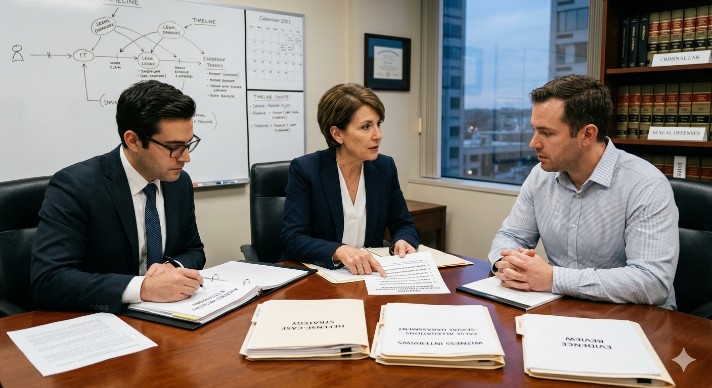
Defending Against False Sexual Harassment Allegations: Employee Legal Guide (USA)
You are sitting at your desk when an email from HR pops up: “We need to meet today regarding a serious matter.” Your stomach drops. Someone has accused you of sexual harassment, and you know the allegation is false. In that moment, panic competes with confusion—how do you prove something did not happen? What you do next can determine whether you keep your job, your reputation, and your career trajectory.
This guide provides a roadmap for navigating false sexual harassment allegations under federal law. We will walk through the legal definitions that govern these claims, the immediate steps you must take to protect yourself, critical filing deadlines, and when to bring in an attorney. Every strategy here is anchored to EEOC guidance and Title VII statutory requirements, giving you the factual foundation to defend your rights without overstepping into legal speculation.
What Constitutes Sexual Harassment Under Title VII?
Understanding the legal framework is your first line of defense in defending sexual harassment claims. Under 42 U.S.C. § 2000e-2, it is unlawful for an employer to discriminate against any individual regarding the terms, conditions, or privileges of employment because of sex. The EEOC interprets this statute to include sexual harassment as a form of sex discrimination.
Sexual harassment takes two primary forms under federal guidelines. The first involves unwelcome sexual advances, requests for sexual favors, or other verbal or physical conduct of a sexual nature that explicitly or implicitly affects employment decisions. The second creates a hostile work environment where the conduct is severe or pervasive enough that a reasonable person would find the workplace intimidating, hostile, or abusive. Conduct meets this threshold when it interferes with work performance or creates an offensive atmosphere, not just when it causes economic injury or discharge.
Who can be involved in these allegations is broader than many employees realize. The harasser may be a supervisor, an agent of the employer, a supervisor in another department, a coworker, or even a non-employee such as a client or vendor. Similarly, the victim does not need to be the person directly harassed; anyone affected by the offensive conduct can file a complaint. This means false sexual harassment allegations can arise from witnessed conduct that the accused never intended as harassment, or from interactions where the accused was not even the primary participant.
When investigating claims, the EEOC examines the totality of circumstances, including the nature of the conduct and the context in which it occurred. This “whole record” analysis means that isolated incidents—unless extremely serious—typically do not meet the legal standard. Understanding these definitions helps you identify exactly what behavior is being alleged and whether it legally qualifies as harassment under Title VII.
Understanding False Accusation Dynamics and Legal Thresholds
Not every accusation that fails to result in discipline is legally “false,” and understanding this distinction is critical when seeking false accusation sexual harassment legal advice. The EEOC distinguishes between false claims, unsubstantiated claims, and malicious claims. A false claim asserts conduct that demonstrably did not occur. An unsubstantiated claim lacks sufficient evidence to prove it happened but does not necessarily mean the accuser fabricated the story. A malicious claim involves intentionally fabricated allegations meant to harm the accused.
The EEOC evaluates harassment allegations by analyzing the entire record, weighing the credibility of statements against contemporaneous evidence. This standard means your defense strategy must focus on concrete documentation rather than simple denials. When an employer conducts an internal investigation, they are assessing whether the conduct more likely than not occurred—not whether it meets the strict legal definition of harassment.
In April 2024, the EEOC issued its updated “Enforcement Guidance on Harassment in the Workplace,” addressing modern issues like virtual harassment. However, this guidance quickly faced legal challenges. Shortly after its release, federal courts in Tennessee and Texas issued preliminary injunctions, blocking the EEOC from enforcing the guidance’s provisions related to gender identity and sexual orientation in several states. These court actions create uncertainty and mean that an employer’s investigation protocols may be based on pre-2024 standards, depending on their location and the specifics of the case.
If you are navigating these complexities, consulting with specialized employment counsel like Coffman Legal, LLC can provide clarity on which current federal standards apply to your specific situation. Their focus on employee rights under federal law helps ensure you are not relying on vacated guidance when building your defense.
The 2024 EEOC Guidance and Ongoing Legal Challenges
On April 29, 2024, the EEOC released its new Enforcement Guidance on Harassment, the first major update in this area for decades. The guidance sought to clarify employer responsibilities regarding remote work, social media, and harassment based on gender identity. However, its implementation has been complicated by legal challenges. Federal courts have issued injunctions pausing the enforcement of parts of the guidance in numerous states. For an accused employee, this means the legal standards your employer is held to during an investigation might be in flux. Your defense strategy must consider whether the employer is following the new guidance, pre-2024 rules, or a mix, which highlights the need for specialized legal advice.
Immediate Steps: What to Do If Falsely Accused of Sexual Harassment
Your immediate actions when falsely accused of sexual harassment create the evidentiary foundation for your entire defense. One of the most critical rules is to avoid any conduct that could be seen as retaliation, which is strictly prohibited by the EEOC.
Preserve every piece of documentation immediately. Screenshot text messages, save emails, and compile calendars showing your whereabouts during alleged incidents. If you had witnesses present during the interactions in question, document their names and contact information now while memories are fresh. Do not delete anything, even if the content seems embarrassing or unrelated. Destroying potential evidence creates a presumption of guilt and can violate company policies regarding record retention.
When HR requests a meeting, cooperate professionally but avoid admissions. Do not say, “I am sorry they felt that way,” as this can be interpreted as an admission of unwelcome conduct. Instead, state clearly that you deny the allegations and request a prompt, thorough investigation. Ask for written notice of the specific allegations against you, including dates, times, and the specific conduct claimed.
Resources like Defending against false sexual harassment claims emphasize that your response during the first 48 hours often determines the trajectory of the investigation. Keep a personal journal of every interaction with investigators, noting dates, times, and the substance of questions asked. This creates a contemporaneous record if the investigation later becomes part of an EEOC charge or litigation.
Navigating Investigations and EEOC Filing Deadlines
Fighting false sexual harassment charges requires understanding the difference between an internal company investigation and a formal EEOC proceeding, especially since you must adhere to strict EEOC time limits for filing a charge. Internal investigations are administrative processes governed by company policy, while EEOC charges trigger federal statutory protections. You must navigate both simultaneously without compromising your rights in either arena.
If you believe you have been wrongfully disciplined or terminated based on false accusations, you have strict deadlines to file an EEOC charge. Generally, you must file within 180 days of the alleged discriminatory act. However, this extends to 300 days if a state or local Fair Employment Practices Agency (FEPA) enforces a law prohibiting the same discrimination. These deadlines are jurisdictional—miss them, and you lose your right to sue under Title VII permanently.
Critically, attempting to resolve the matter through internal grievance procedures, union arbitration, or mediation does not extend these deadlines. The EEOC explicitly states that time limits are not paused while you pursue internal remedies. You can file an EEOC charge while simultaneously participating in internal processes, and in many cases, you should. This parallel filing protects your rights while allowing the employer to complete its investigation.
When responding to HR investigators, answer questions truthfully but concisely. Do not volunteer information beyond the scope of the specific allegation. If asked to provide a written statement, review it carefully before signing, or request to submit it after consulting counsel. Remember that statements made during internal investigations can be used in subsequent EEOC proceedings or litigation.
Understanding the 180-Day and 300-Day Filing Windows
The dual deadline system depends on your geographic location. The 300-day extension applies only if you work in a jurisdiction with a state or local agency authorized to enforce anti-discrimination laws. These FEPAs act as dual filers with the EEOC. If no such agency exists in your state, the strict 180-day rule applies. Note that age discrimination claims operate under different statutory deadlines (ADEA), but sexual harassment claims fall under the Title VII timeline described above. Check your state’s specific framework immediately, as this determination affects your entire legal strategy.
Employer Liability Standards and Your Rights as an Employee
Your employee rights false sexual harassment protections vary significantly depending on who allegedly harassed you. If the accused harasser is a supervisor, the employer faces potential strict liability unless they can assert the affirmative defense established by Supreme Court precedent and EEOC guidance. This defense requires the employer to prove they exercised reasonable care to prevent and correct sexually harassing behavior, and that you unreasonably failed to take advantage of any preventive or corrective opportunities provided by the employer.
For harassment by coworkers or non-employees (such as clients or customers), the liability standard differs. The employer is liable only if they knew or should have known about the harassment and failed to take prompt, effective corrective action. This “knew or should have known” standard places a heavier burden on the complainant to show that management was aware of the conduct.
Title VII coverage applies only to employers with 15 or more employees for each working day in 20 or more calendar weeks in the current or preceding year. If your employer has fewer than 15 employees, federal harassment laws do not apply, though state laws may still provide protection. Regardless of employer size, sexual harassment defense strategy must account for retaliation protections. Federal law prohibits employers from punishing you for asserting your rights to be free from harassment, including filing an EEOC charge, participating in an investigation, or opposing discriminatory practices. This protection applies even if the initial accusation against you was false.
Proving Falsehoods and Defamation Considerations
When proving false sexual harassment allegations, evidence is your only currency. Start by reconstructing timelines using calendar entries, email timestamps, and security badge records to demonstrate you were not present during alleged incidents or that interactions were professional and brief. Gather witness statements from colleagues who observed the interactions in question or who can attest to the accuser’s potential motives or patterns of behavior.
If the investigation concludes in your favor but the accusations have spread beyond the investigators, you may face reputational harm that affects your career. In such cases, defamation false sexual harassment claims may provide a remedy. Under general legal principles outlined by the Cornell Law School Legal Information Institute, defamation requires a false statement purporting to be fact, publication to a third party, fault amounting to at least negligence, and damages.
Libel involves written false statements, while slander involves spoken false statements. In the employment context, if your accuser writes false statements to HR or emails colleagues with fabricated allegations, this could constitute libel. Spoken accusations during meetings may constitute slander. However, defamation law varies significantly by state, and many jurisdictions provide qualified privilege to statements made during internal investigations, meaning you must prove actual malice—not just falsity—to recover damages.
Before pursuing defamation claims, consider the collateral consequences. Litigation can extend the life of the accusations in public records and may be viewed as retaliatory by some courts. Weigh these strategic considerations carefully with counsel who understands your jurisdiction’s specific defamation standards.
When to Seek Legal Help and Build Your Defense Strategy
Certain triggers indicate you need immediate legal help false sexual harassment. If you receive notice of imminent termination, if an EEOC charge has been filed against you, or if defamatory statements have been made to third parties outside the investigation, consult an employment defense attorney immediately. Similarly, if your employer requests you sign a severance agreement waiving claims, legal review is essential before you forfeit your rights.
During an initial consultation, expect to provide a chronological narrative, all documentation you have preserved, and the names of potential witnesses. Attorney-client privilege protects these communications, allowing you to be candid about weaknesses in your position. Your attorney will assess whether the alleged conduct even meets the legal definition of harassment under current EEOC standards, whether procedural violations occurred during the investigation, and whether you have counterclaims for defamation or wrongful termination.
Developing a sexual harassment defense strategy involves choosing between early settlement negotiations and full litigation. Settlement may protect your reputation through confidential resolution and provide financial compensation for lost wages, but it may also restrict future employment in your industry. Litigation offers vindication but involves public filings, depositions, and uncertain timelines. Throughout either process, manage your reputation by maintaining professionalism at your current job, avoiding social media discussions of the case, and requesting neutral reference letters if you depart.
Remember that firms like Coffman Legal, LLC specialize in protecting employees’ rights during these proceedings, offering guidance on whether your employer’s investigation complied with federal standards and whether you have actionable claims for wrongful termination, defamation, or other related torts under state law.
Key Takeaways for the Falsely Accused
First, understand the legal definitions: Title VII requires conduct to be severe or pervasive to constitute illegal harassment, and not every uncomfortable interaction meets this threshold. Second, act immediately to preserve evidence and avoid direct contact with your accuser, while respecting the strict 180- or 300-day EEOC filing deadlines that are not extended by internal processes. Third, know your rights regarding employer liability standards and retaliation protections, and do not hesitate to seek qualified legal counsel when termination or defamation threatens your career.
Facing false accusations is isolating and terrifying, but federal law provides clear procedures for your defense. By grounding your response in documented facts, statutory deadlines, and professional legal guidance, you can protect both your immediate employment and your long-term professional reputation.