Bicycle and Rideshare Accidents in Austin: 2026 Liability Guide
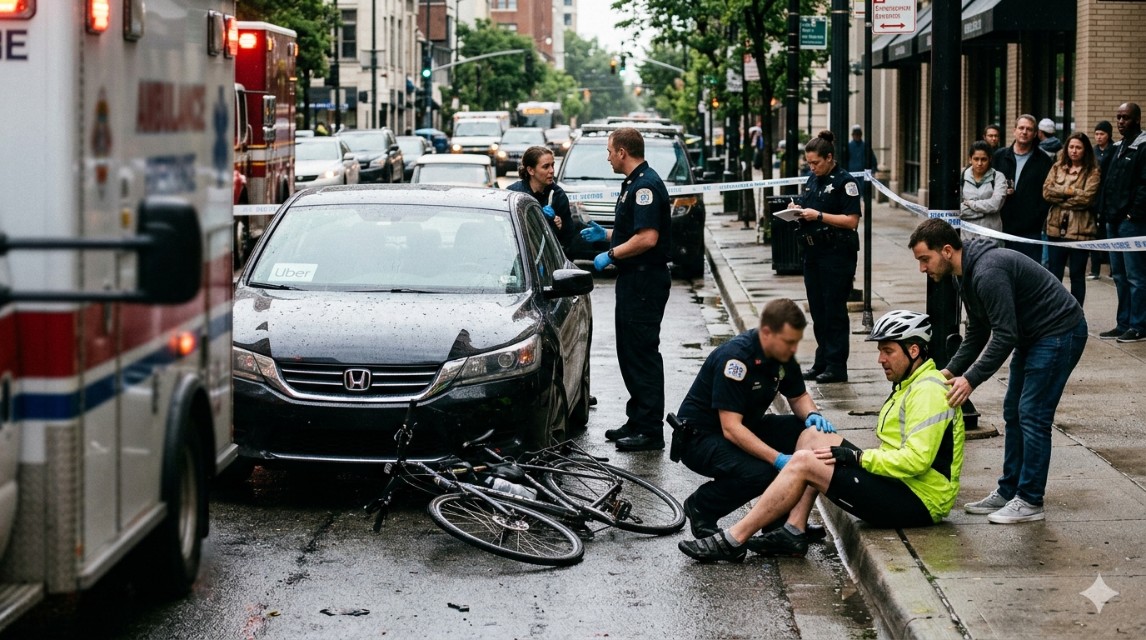
Imagine you’re cycling home from downtown Austin along East Riverside Drive when a rideshare driver cuts across the bike lane to pick up a passenger near the airport. The collision happens in seconds, but the legal aftermath unfolds over months. Suddenly you’re facing medical bills, a damaged bicycle, and conflicting insurance adjusters who can’t agree whether the driver was “working” at the time of impact. You’re not alone—Austin’s dense urban core and high rideshare usage create unique liability scenarios that confuse even experienced cyclists. This guide breaks down exactly what Texas law requires after a crash, how insurance coverage shifts based on app status, and the critical deadlines that could determine whether you recover compensation.
Immediate Steps After a Rideshare or Bicycle Crash in Austin
The moments following a car accident in Austin determine both your safety and your legal options. Under Texas Transportation Code Chapter 550, drivers involved in collisions must immediately stop and determine whether anyone needs aid. If the crash results in injury, death, or vehicle damage exceeding $1,000, you must immediately report it to local police. Failing to stop and render assistance when someone is injured constitutes a serious offense, while exchanging identifying and insurance information remains mandatory for all collisions regardless of severity.
For rideshare accidents specifically, documentation becomes your most valuable asset. Screenshot the driver’s app status immediately—whether it shows “offline,” “waiting for requests,” or an active trip. Request the electronic receipt mandated by state law, which must display the origin, destination, total time, and distance traveled. This receipt proves which insurance phase applied during the crash. You should also photograph the vehicle’s license plate, the damage to both vehicles, and any visible injuries before adrenaline masks them.
Securing an official police report serves as the foundation for any subsequent claim. In Austin, you can access crash reports through the Austin Police Department’s online crash report purchase portal powered by LexisNexis, or through the APD Incident Report Database. Reports purchased through the LexisNexis portal cost $9.00, while copies obtained directly from the city’s public records database typically cost 10 cents per page. If officers responded to your scene, they must file a CR-3 report electronically within 10 days for qualifying collisions involving injury or significant property damage. Do not rely on the old CR-2 self-reporting method—it was retired in 2017 and TxDOT no longer retains those records.
What should you do immediately after a rideshare crash in Austin? Stop safely, check for injuries, call 911 if anyone is hurt or damage exceeds $1,000, exchange information, document the driver’s app status and ride details, and request a police report. What about a bicycle accident? The same statutory duties apply, though you must additionally preserve your helmet, clothing, and bicycle in their post-crash condition as evidence.
Legal Definitions and Special Rules for TNC Crashes
Understanding who pays requires knowing what a “transportation network company” actually is under Texas law. Under Texas Occupations Code Chapter 2402, a TNC is defined as an entity that uses a digital network to connect riders with drivers who provide prearranged rides. The statute creates an independent contractor presumption for drivers when specific statutory conditions are met and a written agreement exists—meaning Uber and Lyft typically avoid vicarious liability for their drivers’ negligence, though their insurance policies still provide coverage.
Texas law broadly preempts municipal regulation of rideshare companies, making it an exclusive state function. Cities cannot impose additional licensing requirements or operational rules on TNCs beyond what the state mandates. However, this preemption contains a critical exception relevant to Austin residents: airport operators may impose specific regulations and reasonable fees on trips originating or terminating at Austin-Bergstrom International Airport. If your crash occurred in the airport rideshare pickup zone or drop-off lanes, local airport authority rules may apply alongside state traffic laws.
What if your crash involved an e-scooter? While electric scooters fall outside the TNC definition, collisions between scooters and rideshare vehicles are analyzed under the same traffic liability frameworks governing any motor vehicle incident. However, evidence collection becomes more complex—you must secure trip records from the scooter company (such as Lime or Bird) in addition to the rideshare driver’s app data to establish timing, route, and potential negligence by either operator.
Airport Pickups and the Exception to State Preemption
While Texas broadly prohibits cities from regulating TNCs differently than other vehicles, Texas Occupations Code Section 2402.003(b) and (d) explicitly allows airport operators to impose regulations and reasonable fees on rideshare trips. At Austin-Bergstrom International Airport, this means designated pickup zones, specific staging areas, and airport-specific fees may apply. If your collision occurred during an airport pickup or drop-off, these local operational requirements could affect fault determination or reveal regulatory violations by the driver.
E-Scooters and Shared Mobility Devices
Accidents involving rented electric scooters and rideshare vehicles navigate the same modified comparative fault framework as bicycle crashes. However, the evidentiary trail expands—you need the scooter company’s trip records showing speed, GPS path, and braking data alongside the rideshare driver’s electronic receipt and platform records. Both devices generate digital timestamps that can synchronize to reconstruct the exact sequence of events.
How Rideshare Insurance Coverage Works by App Status
Texas Insurance Code Chapter 1954 creates a three-phase insurance system that determines who pays if an Uber or Lyft driver hits a bicyclist. The coverage available depends entirely on what the driver was doing at the moment of impact.
Phase One: App Off. When the driver is offline, only their personal auto insurance applies. If they carry minimum liability coverage or lack commercial ride-for-hire coverage, you may face significant gaps in compensation.
Phase Two: App On, Waiting for Requests. Once the driver logs into the app but before accepting a ride, Texas Insurance Code Section 1954.052 mandates minimum liability coverage of $50,000 per person, $100,000 per accident, and $25,000 for property damage. The TNC must also provide uninsured/underinsured motorist coverage and personal injury protection where required.
Phase Three: Active Prearranged Ride. From the moment the driver accepts a request until the last passenger exits, Section 1954.053 requires a $1,000,000 aggregate liability policy per incident, plus UM/UIM and PIP coverage. This represents the highest coverage level available.
Critically, if the driver’s personal insurance lapses or is insufficient, the TNC must provide first-dollar coverage from the first dollar of the claim—they cannot wait for the personal insurer to deny the claim first. Furthermore, TNC coverage is primary and not contingent upon the personal insurer’s denial. The driver also bears a legal duty to disclose their app status and provide proof of insurance upon request at the accident scene.
Does rideshare insurance change if the driver is waiting for a ride request? Yes—it drops to the lower $50,000/$100,000 minimums. Does it change once a trip is accepted? Yes—coverage jumps to $1 million. What if the personal insurance denies the claim? The TNC’s policy still covers the loss from dollar one.
Proving App Status After the Crash
Establishing which insurance phase applied requires specific evidence: the driver’s verbal disclosure of app status, the electronic receipt showing origin and destination mandated by Texas Occupations Code Section 2402.105, and platform records obtainable through litigation hold letters. Texas law explicitly prohibits defendants from delaying recovery by disputing these facts—the coverage obligation exists regardless of such disagreements.
Determining Fault When a Cyclist and Rideshare Driver Collide
Texas employs modified comparative fault under Texas Civil Practice & Remedies Code Chapter 33. If you bear more than 50% responsibility for the crash, you cannot recover any damages. If you are 50% or less at fault, your compensation reduces proportionally—being 20% at fault reduces a $100,000 award to $80,000.
Can more than one party be liable? Absolutely. The rideshare driver may bear fault for an illegal lane change while you share responsibility for an equipment violation. Under Texas Transportation Code Chapter 551, cyclists generally possess the same rights and duties as motor vehicle drivers, but specific bicycle statutes govern road positioning. The “right-edge rule” requires cyclists moving slower than traffic to ride near the right curb, except when passing another vehicle, preparing for a left turn, avoiding hazards, or when the lane is too narrow for a bicycle and vehicle to travel safely side-by-side.
Equipment violations significantly impact fault allocation. Section 551.104 mandates that bicycles operated at night must display a front white light visible from 500 feet and a red reflector visible from 50 to 300 feet, or a red light visible from 500 feet to the rear, plus functional brakes. While failure to use these lights doesn’t automatically bar recovery, insurers and juries may assign comparative responsibility percentages that push you past the critical 51% threshold.
What if you were partially at fault? You can still recover if your responsibility doesn’t exceed 50%, though your damages decrease accordingly. Can you recover if you weren’t wearing bike lights at night? Possibly, but expect the defense to argue contributory negligence based on the visibility violation.
Filing Deadlines and Evidence Requirements for Austin Cases
Texas law imposes strict deadlines that kill valid claims if missed. Under Texas Civil Practice & Remedies Code Section 16.003(a), you have two years from the accident date to file a personal injury lawsuit. For wrongful death claims, the two-year clock starts ticking at the moment of death under Section 16.003(b).
How do you get an Austin Police crash report? Visit the Austin Police Department’s crash report portal or query the APD Incident Report Database. The city charges 10 cents per page for copies. Remember that officers must file CR-3 reports electronically within 10 days for collisions involving injury, death, or property damage exceeding $1,000.
Does TxDOT still keep CR-2 driver crash reports? No. The CR-2 form was retired effective September 1, 2017, and TxDOT’s retention period expired on January 1, 2019. Do not waste time requesting these from the state—focus on obtaining the officer-filed CR-3 report instead.
In the first week after a crash, preserve these documents: the police report number, all medical records and bills, photographs of the scene and injuries, the rideshare electronic receipt, screenshot proof of the driver’s app status, witness contact information, and your own insurance correspondence. Store physical evidence like damaged clothing and your bicycle without repairing them.
The Retirement of CR-2 Self-Reporting
The CR-2 driver crash report form—previously used when police didn’t respond to minor collisions—was retired effective September 1, 2017. Because the retention period expired January 1, 2019, TxDOT no longer retains these records. If police didn’t file a CR-3 report and you previously completed a CR-2, that document likely no longer exists in state records, making independent evidence collection even more critical.
Wrongful Death and Survival Actions After Fatal Crashes
When a bicycle accident results in death, Texas law provides two distinct legal paths with different beneficiaries and purposes. Understanding the difference between wrongful death and survival claims prevents costly procedural errors during an already traumatic time.
A wrongful death claim under Texas Civil Practice & Remedies Code Chapter 71 exists for the exclusive benefit of the surviving spouse, children, and parents of the deceased. These beneficiaries seek compensation for their own losses—loss of companionship, mental anguish, and lost financial support. A survival action, by contrast, represents the claim the deceased person could have brought had they lived; it continues through the estate’s executor or administrator and covers the decedent’s medical expenses, pain and suffering before death, and funeral costs.
The law imposes a critical three-month trigger: if eligible beneficiaries do not initiate a wrongful death action within three calendar months after the death, the executor or administrator shall bring the action unless all beneficiaries request otherwise. This provision prevents indefinite delays while ensuring the estate can proceed if family members are incapacitated by grief.
How long do families have to file? Both claims generally face a two-year statute of limitations from the date of death. Missing this deadline typically bars recovery entirely, making early consultation with a bicycle accident lawyer essential for preserving these claims.
Next Steps: Hiring a Bicycle Accident Attorney in Austin
After securing medical treatment and initial evidence, understanding insurance timelines helps you avoid early mistakes. Under Texas Insurance Code Chapter 542, insurers must acknowledge your claim and begin their investigation within 15 days, and must accept or reject the claim within 15 business days after receiving all requested information. Delays beyond these statutory periods may trigger bad faith penalties.
Preserve all electronic evidence immediately—rideshare receipts disappear from apps after certain periods, and scooter company trip data may auto-delete. Screenshot everything now: the driver’s profile page showing their rating and photo, the trip map, your payment confirmation, and any in-app communications.
You should consult a bicycle accident lawyer if you suffered severe injuries requiring surgery or extended care, if fault is disputed and you risk bearing more than 50% responsibility, if the crash resulted in wrongful death, or if you face coverage gaps requiring first-dollar litigation against the TNC. Most reputable attorneys offer free consultations and work on contingency fees, meaning you pay nothing unless they secure recovery.
Austin’s streets demand vigilance from cyclists and accountability from rideshare operators. By understanding the three insurance phases, the 51% comparative fault bar, and the two-year filing deadline, you protect your right to compensation after a collision. If you’re navigating these complex issues, consider speaking with a qualified attorney who can evaluate your specific app status evidence and fault allocation before critical deadlines expire.