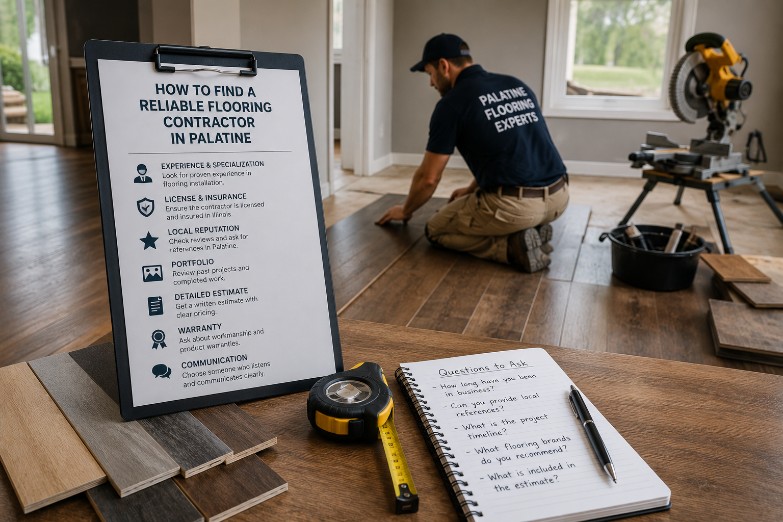
How to Find a Reliable Flooring Contractor in Palatine
You’ve finally picked out the perfect hardwood for your living room, or maybe you’re swapping tired carpet for waterproof luxury vinyl in the basement. A week later, you’re staring at buckling planks, unanswered calls, and a contract that says nothing about moisture testing. Finding skilled flooring professionals in the Northwest suburbs shouldn’t feel like a gamble. This guide walks you through the specific credentials, local permit rules, and contract protections you need to hire with confidence—and avoid the expensive mistakes that trap too many Palatine homeowners.
H2: Understanding Flooring Installation Palatine: Scope and Permit Requirements
Every flooring type carries its own installation demands. Solid hardwood requires acclimation and nail-down expertise, while luxury vinyl plank (LVP) floats or glues depending on the subfloor. Laminate also floats but demands tight expansion gaps and precise underlayment. Tile needs cement board or crack-isolation membranes, and carpet requires power stretching and seam sealing. These differences matter because an installer who excels at carpet may lack the moisture-testing rigor hardwood demands.
Before you sign, confirm whether Illinois’ Home Repair and Remodeling Act (815 ILCS 513) even covers your project. The statute explicitly excludes the “sale, installation, cleaning, or repair of carpets” from its definition of home repair and remodeling. If you’re installing carpet only, you lose statutory written-contract protections, making your vetting process even more critical.
Next, check local requirements. The Village of Palatine’s Building & Inspection Services Division lists “installing new flooring” among projects that require a permit check. Replacement-in-kind may not trigger a permit, but altering subfloors, changing heating systems beneath the floor, or modifying load-bearing walls during the install usually does. Always call the Village before demo begins to confirm whether your specific scope needs inspection.
Finally, if your home was built before 1978 and the work will disturb painted baseboards, trim, or window stools, the EPA’s Renovation, Repair and Painting (RRP) Rule applies. Certified firms must use lead-safe work practices when disturbing painted surfaces in older housing. Ask whether your contractor holds EPA RRP certification; disturbing even six square feet of interior painted surface per room triggers the rule.
Finding a contractor who navigates these layers—material expertise, state carpet carve-outs, Village permits, and federal lead rules—sets the foundation for a lasting installation. For complex installations requiring precision, many homeowners turn to established professionals like Simple Flooring Co. to handle everything from engineered hardwood to waterproof LVP.
H2: Why Local Flooring Palatine Service Matters
Hiring an Illinois-based crew offers tangible advantages over national chains or fly-by-night operators. Local flooring companies understand Palatine’s seasonal humidity swings—freeze-thaw cycles that can expand and contract wood subfloors—and they stock materials suited to Midwestern climate stress. They also know the Village’s inspection quirks, such as specific hours for rough inspections or how to schedule same-day re-inspections if a job fails the first walk-through.
Accountability stays sharper when the owner lives in Cook or Lake County. You can verify the business actually exists through the Illinois Secretary of State’s Business Search, which provides File Detail Reports showing official entity names, formation dates, registered agents, and active status. A national subcontractor using a rented mailbox may vanish after the final invoice; a local entity with a registered street address has long-term reputation stakes.
Warranty service becomes less theoretical when the showroom is twenty minutes away. If a plank pops or a grout line cracks, a local flooring company can dispatch a service tech quickly. National retailers often route warranty claims through out-of-state call centers, leaving you waiting weeks for resolution. The Illinois Attorney General’s Home Repair resources emphasize checking physical business location before signing to ensure you can reach the contractor if defects appear.
H2: Verifying Credentials: Licensed Flooring Contractor Palatine Standards
Illinois does not license flooring contractors at the state level the way it licenses plumbers or roofers. The Illinois Department of Financial and Professional Regulation (IDFPR) License Lookup covers professions like architects or home inspectors, but many contractor categories fall outside its database. “Not found” does not necessarily mean unqualified; it may simply mean the profession isn’t state-licensed.
Start your verification with the Illinois Secretary of State to confirm the business entity is active and in good standing. Then move to insurance. Under 815 ILCS 513/25, home repair businesses must maintain public liability and property damage insurance meeting statutory minimums, unless they demonstrate a net worth exceeding $1,000,000. Demand a certificate of insurance (COI) naming you as additional insured for the project duration, then call the carrier to confirm the policy is active.
Workers’ compensation coverage is non-negotiable when employees are on-site. Illinois provides an Employer’s Workers’ Compensation Insurance Coverage Search to verify policies. Be aware the database excludes employers in self-insurance pools regulated by the Illinois Division of Insurance. If your contractor claims self-insurance, request documentation directly from their administrator.
Before hiring, ask: Will you provide a Certificate of Insurance (COI) that names me, the homeowner, as an additional insured for the project? Will you provide lien waivers for all subs and suppliers? How do you handle change orders? Their answers reveal whether they follow the procedural rigor that separates reliable flooring Palatine professionals from casual handymen.
H2: How to Evaluate Flooring Estimates Palatine
Illinois law mandates a written contract or work order for home repair work exceeding $1,000. The document must itemize parts and materials, specify total cost, and include any charge for an estimate. The Illinois Attorney General’s “Home Repair and Construction” guide reinforces that vague verbal bids leave you no recourse if the final bill doubles.
For flooring specifically, an itemized estimate should break out: demolition and disposal of old flooring, subfloor preparation (leveling compounds or sanding), underlayment, flooring material, transitions between rooms, trim or baseboard installation, floor protection during the curing period, and cleanup. The FTC advises that written estimates include a description of the work, materials, completion date, and price to enable fair comparison.
Collect at least three bids. When comparing, ensure scopes align—one bid might include furniture moving while another treats it as extra; one might assume the subfloor is ready while another budgets for self-leveling. Ask about payment schedules. While deposits are standard, Illinois law and best practices suggest withholding final payment until the work is complete, inspected, and all lien waivers are signed. Never pay the full balance upfront.
H2: Spotting Red Flags: Flooring Reviews Palatine and Scam Prevention
High-pressure sales tactics often signal trouble. If a contractor offers a “today only” discount or claims your roof will leak unless you sign immediately, step back. Scammers frequently refuse to provide written contracts or demand large cash deposits before materials arrive.
Under 815 ILCS 513/15, Illinois contractors must disclose their business name and address in writing. If they use a post office box or mail-receiving service, they must also provide their residence address. An untraceable P.O. box without a physical location is a major warning sign.
Online reviews require skeptical reading. The FTC notes that patterns matter more than isolated complaints. Look for repeated mentions of no-shows, hidden charges, or dust left coating furniture. Conversely, vague five-star reviews posted within the same week may indicate fake feedback. Cross-reference reviews with the Illinois Attorney General’s Home Repair Fraud page to see if the company has generated complaints.
Before hiring, verify the contractor carries current insurance, check their workers’ comp status, and confirm their entity is active with the Secretary of State. These steps cost minutes and prevent months of litigation.
H2: Protecting Your Investment: Contracts and Illinois Consumer Rights
Your contract is your shield. For projects over $1,000, Illinois statute requires the document to list total costs, materials, and start/completion dates. Contractors must also provide the “Home Repair: Know Your Consumer Rights” pamphlet before you sign, and you must acknowledge receipt with a dated signature. This pamphlet details your three-day cancellation rights and warning signs of fraud.
If the contract includes binding arbitration or jury-trial waiver clauses, the contractor must advise you before execution and give you the option to accept or reject each provision separately. Don’t gloss over these pages; they determine where you’ll fight if the installer damages your subfloor.
H3: Understanding Your 3-Day Cancellation Rights
You may cancel a home repair contract within three business days if the sale occurs at your residence, involves $25 or more, and you did not solicit the visit. The FTC Cooling-Off Rule (16 CFR Part 429) provides parallel federal protections, requiring duplicate cancellation notices in your contract. Exemptions include emergencies or repairs you requested beforehand. Exercise this right by midnight of the third business day using written notice; keep a copy for your records.
H3: Navigating Lien Waivers and Final Payment Protection
Illinois public policy voids advance lien waivers—agreements to waive lien rights “in anticipation of” the contract award are unenforceable. You should only sign lien waivers after paying, not before. Once you pay in full, the contractor has ten days to acknowledge satisfaction of the lien upon written demand; failure incurs a $2,500 statutory penalty. Withhold final payment until you hold signed releases from the contractor and all material suppliers to protect your title.
H2: Selecting From the Best Flooring Contractors Palatine
With finalists narrowed, probe their technical depth. For carpet, ask about power-stretching methods and whether seams will fall in low-traffic areas. Since carpet-only jobs fall outside the Home Repair and Remodeling Act’s written-contract mandate, insist on a detailed agreement anyway; HRRA protections may not apply, but your contract terms still govern.
For LVP or laminate, ask about expansion gap planning around fireplaces and doorways. For tile, query waterproofing membranes and deflection ratings.
When hiring a Palatine flooring contractor, confirm who handles furniture moving, old flooring removal, and disposal. Clarify the timeline: carpet often takes a day, while nail-down hardwood may require three to five days plus acclimation. Demolition sometimes reveals subfloor damage; establish a written change order protocol now so you’re not negotiating prices with exposed plywood.
H3: Hardwood-Specific Technical Screening
Hardwood demands rigorous moisture verification. The National Wood Flooring Association (NWFA) calls moisture testing “compulsory practice” and prohibits installing over known moisture conditions. Ask your contractor to document subfloor moisture content; NWFA guidelines suggest subfloor moisture should not exceed 4% above solid strip flooring (<3” widths) or 2% above plank (≥3” widths). If they skip this step or dismiss it as unnecessary, choose another installer.
H2: Final Preparations for Project Day
After signing, photograph existing conditions—walls, trim, and adjacent flooring—to document pre-project status. Clear the room of fragile items unless your contract includes furniture moving. Verify that moisture testing occurred for hardwood and that results are documented; NWFA standards prohibit installation over known moisture issues.
If your home predates 1978 and baseboards will be disturbed, confirm the crew follows EPA RRP lead-safe practices, including containment and HEPA vacuuming. Review warranty documents: manufacturer warranties cover defects in the plank or tile, while installation labor warranties cover workmanship errors like gaps or squeaks. Keep both documents with your contract.
H3: Documentation and Change Order Protocols
If demolition reveals rotted subfloor or asbestos tile, work stops until you approve a written change order detailing additional costs and timeline shifts. Never approve scope changes verbally. Update your photo log daily, capturing moisture readings and material lot numbers. This paper trail transforms “he said/she said” disputes into resolvable claims backed by timestamped evidence.
Choosing a flooring contractor in Palatine means balancing technical skill, legal protections, and local accountability. Verify insurance and workers’ comp, demand written contracts that comply with Illinois HRRA requirements, and never skip moisture testing on hardwood. By following these steps, you protect your floors—and your investment—for decades.
Key Takeaways: – Verify Illinois business status, insurance, and workers’ compensation before hiring. – Insist on written, itemized contracts for jobs over $1,000 and know your three-day cancellation rights. – Require documented moisture testing for hardwood and EPA RRP compliance for pre-1978 homes.
Ready to start your project? Gather your measurements, check the Village of Palatine permit requirements, and schedule consultations with contractors who meet these standards.