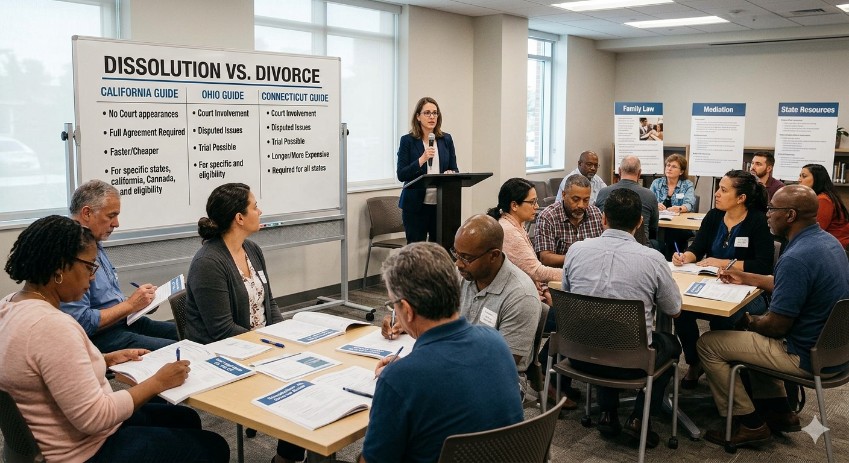
Dissolution vs. Divorce: A Guide for California, Ohio & Connecticut
When you decide to end your marriage, the legal terminology alone can feel overwhelming. You might hear “dissolution,” “divorce,” and “summary dissolution” used interchangeably, only to discover that your friend in Ohio followed a completely different process than your cousin in California. Understanding whether you qualify for a streamlined cooperative process—or must navigate a contested court battle—can save you months of stress and thousands of dollars. This guide walks you through the concrete differences between dissolution and divorce across California, Ohio, and Connecticut, providing state-specific requirements, realistic timelines, and safety considerations to help you choose the right path forward.
Understanding the Differences Between Dissolution and Divorce
The differences between dissolution and divorce depend heavily on which state courthouse you’re standing in. In California, the terms are functionally synonymous. According to the California Courts Self Help Guide, the legal word for divorce is “dissolution of marriage,” and the process describes the legal termination of a marriage or domestic partnership. If you file paperwork in Los Angeles or San Francisco, you are technically filing for dissolution, though most people simply call it divorce.
However, cross into Ohio, and the terminology shifts dramatically. As explained by Ohio Legal Help, divorce and dissolution represent distinct legal pathways. A divorce in Ohio is a lawsuit where one spouse sues the other, requiring legal grounds such as incompatibility, adultery, or cruelty, and proceeds even if one party objects. Dissolution, conversely, is a non-adversarial process where both spouses agree on every single issue—property division, debt allocation, spousal support—before filing any paperwork. No grounds are required because there is no contest.
So, is divorce the same as dissolution in California? Essentially, yes. California law treats dissolution as the umbrella term for ending a marriage, whether contested or not. But what does dissolution of marriage mean in different states? In Ohio and Connecticut, it typically signals a cooperative, agreement-based process, while “divorce” implies litigation. This distinction matters because it determines whether you and your spouse must negotiate every detail privately or prepare for a judge to decide your future.
When seeking professional guidance on these variations, firms like Dailey Law Group emphasize that understanding your state’s specific dissolution of marriage process is the first step toward an efficient separation. The process fundamentals generally involve filing a petition (or joint petition), meeting residency requirements, and waiting for a mandatory period before the judgment becomes final. Yet the emotional and financial landscape differs wildly depending on whether that process is adversarial or amicable.
Uncontested vs Contested Divorce: How Cooperation Affects Your Path
The distinction between uncontested vs contested divorce determines everything from your timeline to your stress level. In an uncontested scenario—often called an amicable divorce or cooperative dissolution—you and your spouse resolve property, debt, and support issues privately. This alignment makes you eligible for streamlined amicable divorce procedures that bypass lengthy court battles.
Do both spouses have to agree to get a dissolution? In states like Ohio and Connecticut that offer distinct dissolution pathways, the answer is an absolute yes. According to Ohio Legal Help, dissolution requires complete agreement on every element; if you disagree on even one asset, you cannot file for dissolution and must pursue a traditional divorce instead. Similarly, Connecticut’s nonadversarial dissolution statutes require a joint petition with sworn attestations that both parties concur on all terms.
What happens if one spouse contests the divorce? The case converts from a cooperative dissolution into a contested divorce proceeding. A judge or magistrate then assumes decision-making authority, scheduling hearings to resolve disputes over parenting time, property valuation, or spousal support. This adversarial track typically requires discovery processes, mandatory settlement conferences, and potentially a trial—extending the timeline from weeks to months or even years.
The Connecticut General Assembly codifies this bifurcation clearly: nonadversarial dissolution is available only when no protective orders exist and both parties waive their right to a contested hearing. If safety concerns or fundamental disagreements arise, the court transfers the case to the standard divorce docket, where litigation rules apply. Understanding this threshold is crucial; cooperation isn’t just preferable in these jurisdictions—it’s a mandatory gatekeeper for simplified options.
Simplified Divorce Requirements in California, Ohio, and Connecticut
If you meet specific criteria, you may qualify for simplified divorce requirements that dramatically reduce paperwork and court appearances. These quick divorce options vary significantly by state, so verify your eligibility before assuming you can bypass standard procedures.
California’s Summary Dissolution offers a faster route for couples with limited legal entanglements. To qualify, you must meet strict uncontested divorce requirements: your marriage must be under five years, you cannot have children together, you must own minimal property and debt (specifically, less than the specified community property limits and no real estate holdings), and both parties must waive spousal support rights. Additionally, California mandates that at least one spouse must have lived in the state for six months and in the specific county for three months before filing. This residency rule applies to all California divorces, not just summary dissolutions.
Ohio’s Dissolution provides another cooperative pathway, though it functions differently than California’s approach. Rather than limiting eligibility based on marriage duration or assets, Ohio requires complete consensus. You must execute a separation agreement covering all property, debts, and spousal support before filing. This agreement becomes part of the final judgment. If you have children, you must also file a shared parenting plan or custody arrangement that both parents endorse.
Connecticut’s Nonadversarial Dissolution statute establishes specific statutory conditions: your marriage must not exceed nine years; you cannot have any children together; you must not own any real estate; your combined property value, net of debt, must be under $100,000; and neither party can have a defined benefit pension plan or pending bankruptcy proceedings. Crucially, the Connecticut General Assembly prohibits this streamlined option if any restraining or protective orders exist between the parties.
California Summary Dissolution Basics
California’s six-month residency rule requires six months in the state and three months in the county before you can file. The summary dissolution imposes a five-year marriage limit and a six-month mandatory waiting period before the judgment becomes final—meaning you cannot remarry until that date passes. Filing fees range from $435–$450, though fee waivers are available for qualifying low-income filers. During this waiting period, you remain legally married, which affects tax filing status and healthcare coverage decisions.
Ohio and Connecticut Cooperative Pathways
Ohio and Connecticut handle final hearings differently. In Ohio, both spouses must appear at the final dissolution hearing to confirm their agreement under oath; the court will not grant a dissolution in absentia. Connecticut, however, allows parties who are in complete agreement and have no protective orders to request entry of judgment without a court appearance, provided they submit sworn affidavits attesting to the fairness of their agreement. This remote approval option can save significant time for qualifying Connecticut couples.
Cost of Divorce vs Dissolution and Realistic Timelines
Understanding the cost of divorce vs dissolution helps set realistic expectations for both your budget and your calendar. In California, a summary dissolution costs between $435–$450 in filing fees, with a mandatory six-month waiting period before the judgment is final. This means that even if you file today, you cannot remarry for six months, and you remain legally married until that judgment date arrives.
Ohio presents a stark contrast between cooperative and adversarial timelines. According to Ohio Legal Help, a dissolution typically takes 30–90 days from filing to final judgment, provided both parties maintain their agreement and appear at the hearing. A traditional contested divorce, however, generally requires four months to a year or more, depending on court congestion and the complexity of disputed assets. This efficiency makes dissolution attractive for eligible couples, though it requires upfront agreement on every issue.
Connecticut’s nonadversarial dissolution offers a 30-day minimum disposition period under statutory guidelines, though practical processing may take slightly longer depending on court scheduling. Traditional Connecticut divorces often extend six months or more when contested.
When evaluating these quick divorce options, remember that initial filing fees represent only part of the equation. Contested divorces incur additional costs for discovery, expert valuations, and attorney fees that can escalate quickly. By contrast, cooperative dissolution paths typically require only the initial filing fee and potential notarization costs. For a deeper analysis of why couples choose cooperation over litigation, consider reading about Dissolution vs. traditional divorce considerations specific to Ohio law.
Filing for Divorce Without a Lawyer: Eligibility and Safety Considerations
Filing for divorce without a lawyer is feasible for many couples seeking simplified dissolution, but it requires honest assessment of your situation. Self-filing works best when you have simple estates, full agreement on all issues, and no significant power imbalances between spouses. If you own only modest bank accounts, have no children, and agree on property division, standardized court forms often suffice.
However, certain situations demand legal counsel. Complex assets requiring valuation—such as businesses, extensive investment portfolios, or retirement accounts—necessitate professional guidance to ensure equitable division. More critically, safety concerns override DIY options. Connecticut explicitly prohibits nonadversarial dissolution when restraining or protective orders exist, as noted by the Connecticut Judicial Branch. If you fear for your safety or your children’s safety, cooperative dissolution is likely not available or safe, and you should consult an attorney immediately.
In Ohio, the Supreme Court of Ohio provides standardized forms for dissolution without children, including Form 17 (Petition for Dissolution), Form 19 (Separation Agreement), and Form 18 (Judgment Entry). These forms ensure you meet statutory requirements, but they do not provide legal advice. If your spouse controls the finances or has threatened you, attempting cooperative dissolution could expose you to coercion.
Can you request a final divorce judgment without a court hearing if you fully agree? In Connecticut, yes—the remote filing procedures allow judgment without appearance when parties submit complete agreements and affidavits. California’s summary dissolution is designed to be completed by mail without a court hearing, provided all paperwork is correctly filed, while Ohio mandates both spouses attend the final hearing. When is a cooperative dissolution process not available or safe? When protective orders exist, when one party refuses to disclose assets, or when complex financial holdings require expert tracing.
Choosing the Right Path Forward
When is dissolution preferable to divorce? Generally, dissolution serves cooperative couples with simple financial situations, no children or real estate, and no history of domestic violence. It preserves privacy, reduces costs, and allows you to control the outcome rather than risking a judge’s decision. Amicable divorce procedures work when both parties commit to transparency and fairness.
Traditional divorce becomes necessary when you face disputed assets, grounds-based filings (in states requiring them), or safety concerns. If your spouse refuses to negotiate, hides assets, or poses a threat, attempting dissolution wastes time and emotional energy better spent on protective litigation.
Ready to start? If you qualify for simplified processes, gather your financial affidavits first. In Ohio, for a dissolution without children, you’ll start with forms like Form 17 (Petition for Dissolution), Form 19 (Separation Agreement), and Form 18 (Judgment Entry). In Connecticut, prepare the JD-FM-242 Joint Petition for Nonadversarial Divorce along with supporting affidavits. In California, review the Summary Dissolution checklist to confirm you meet the five-year marriage limit and residency requirements.
Ultimately, dissolution vs divorce isn’t just about legal terminology—it’s about choosing a process that matches your circumstances, safety needs, and financial complexity. By understanding your state’s specific requirements, you can move forward with clarity and confidence.
Key Takeaways: 1. Terminology varies by state: In California, dissolution and divorce are synonymous; in Ohio and Connecticut, dissolution specifically means a cooperative, agreement-based process. 2. Agreement is mandatory for dissolution: You cannot pursue simplified dissolution without complete consensus on property, debt, and support—if disagreement exists, you must file for contested divorce. 3. Safety first: Protective orders or power imbalances disqualify you from cooperative dissolution and necessitate traditional divorce proceedings with legal representation.
If you’re uncertain which path fits your situation, consult your state’s self-help legal resources or a licensed family law attorney to review your specific eligibility before filing any paperwork.