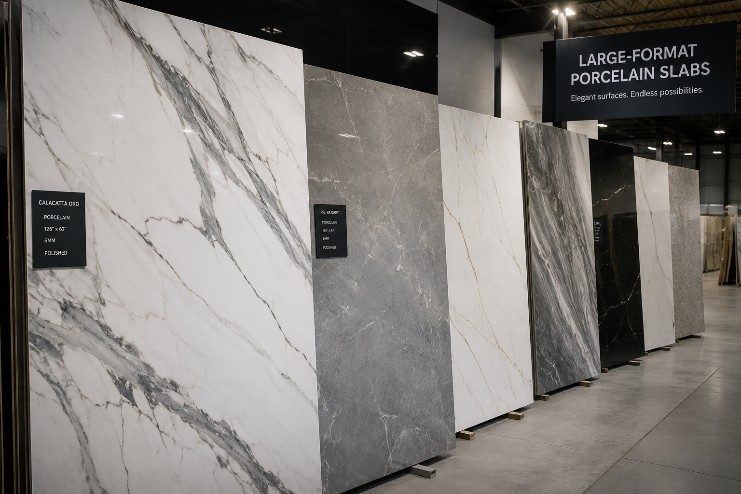
Large-Format Porcelain Slabs: A Guide to Modern Minimalism
You walk into a newly renovated kitchen where the countertop appears to flow directly into the backsplash without a single seam. The floor stretches wall-to-wall with barely visible grout lines, creating an uninterrupted canvas that makes the room feel expansive and serene. This isn’t magic—it’s the precision of large-format porcelain slabs transforming modern interiors. As homeowners and designers across the USA increasingly embrace clean lines and uncluttered spaces, understanding how to specify and install these materials correctly becomes essential. This guide cuts through the marketing noise to give you the technical knowledge and design insights needed to achieve truly seamless interior surfaces that last.
Understanding Large-Format Porcelain Slabs and U.S. Standards
When you specify porcelain slabs for a project, you’re working with materials governed by rigorous American National Standards Institute (ANSI) specifications. According to ANSI A137.1, porcelain tile is defined as ceramic tile with water absorption of 0.5% or less when tested per ASTM C373 methods. This testing protocol, which involves boiling samples and measuring weight gain, creates the definitive threshold between porcelain and non-porcelain ceramic products. The Porcelain Tile Certification Agency (PTCA)—established jointly by the Ceramic Tile Distributors Association (CTDA) and the Tile Council of North America (TCNA)—verifies compliance with these standards. When you see the PTCA Certification Mark on a product, it guarantees the material meets the ANSI A137.1 definition of true porcelain, backed by documented ASTM C373 testing results.
Here’s where terminology gets tricky: while large format porcelain dominates design conversations, ANSI A137.1 does not formally define “large-format” for ceramic tile. The standard does define large-format for glass tile under ANSI A137.2, but for ceramic products, the industry relies on practical usage. For context, Tile of Spain benchmarks large-format ceramic slabs as surfaces exceeding 10 square feet with at least one side longer than 120 centimeters (approximately 47 inches). Additionally, the industry distinguishes standard porcelain slabs from Gauged Porcelain Tile Panels/Slabs (GPTP), which fall under separate standards: ANSI A137.3 and ANSI A108.19. These GPTP standards address the specific requirements for ultra-thin, large-format porcelain products that require specialized handling and installation techniques.
The Minimalist Aesthetic: Seamless Interior Surfaces and Visual Continuity
Modern minimalism relies on visual calm, and large-format slabs deliver this through dramatic reduction of grout lines. Traditional tile installations create grids of interruptions; large-format porcelain slabs minimize these breaks, allowing stone, concrete, or abstract patterns to read as continuous natural surfaces. However, achieving this seamless look requires more than just big tiles—it demands attention to visual consistency standards built into ANSI specifications.
ANSI A137.1:2022 establishes aesthetic variation classes V0 through V4 to help designers specify appropriate uniformity. V0 indicates virtually no visible variation between pieces—ideal for the monolithic look of minimalist interior design. V1 offers uniform appearance, while V2 through V4 introduce moderate to random variation. For seamless aesthetics, you’ll typically want V0 or V1 classifications to ensure that adjacent slabs don’t create distracting visual breaks.
Contrary to intuition, large tiles don’t overwhelm small rooms—they expand them. Research on spatial perception demonstrates that fewer grout lines create visual continuity that extends perceived boundaries. When you reduce the grid pattern that chops up floor space, the eye travels uninterrupted across the surface, making bathrooms and compact kitchens feel significantly larger. The key lies in proportion and layout: surrounding large-scale elements with appropriate negative space and consistent lighting prevents the material from dominating the room while maintaining the clean, expansive feel characteristic of seamless interior surfaces.
Applications in Modern Home Design: Floors, Walls, and Countertops
Porcelain countertops and seamless flooring represent the fastest-growing applications for large-format slabs in residential construction. Unlike traditional materials that require seams every few feet, these surfaces can cover entire islands or bathroom floors with minimal interruption. In modern kitchens, slabs extend from countertops vertically up backsplashes, eliminating the typical grout line where horizontal meets vertical. This creates the wrap-around aesthetic that defines contemporary modern kitchen design.
Large-format porcelain outperforms smaller tiles in wet areas and high-traffic zones because fewer joints mean fewer opportunities for moisture penetration and staining. The material works equally well for flooring and vertical applications, though installation approaches differ significantly between horizontal and vertical surfaces.
Kitchen and Countertop Integration
The kitchen island becomes a sculptural element when wrapped in continuous porcelain. Slabs can integrate with undermount sinks and cooktops to create monolithic surfaces where the material flows uninterrupted from counter to backsplash to waterfall edge. This eliminates the visual clutter of silicone joints and grout lines, allowing the material’s pattern to dominate rather than the installation geometry.
Flooring and Vertical Surface Applications
In bathrooms, large-format slabs create spa-like environments where floor and wall planes meet with minimal transition lines. The same material can extend from shower floors to ceiling, creating wet-room aesthetics that feel expansive and hotel-inspired. Vertical applications require specialized setting materials and handling due to weight, but the result eliminates the grid-like appearance of traditional tile layouts.
Installation Realities: Substrate Standards and Movement Joints
The beautiful illusion of groutless surfaces requires rigorous technical preparation behind the scenes. Large format tile installation demands substrate flatness that exceeds traditional ceramic requirements. ANSI A108.02 specifies that for tiles with any edge measuring 15 inches or greater, the substrate must not vary more than 1/8 inch in 10 feet, with no more than 1/16 inch variation in 24 inches. These tolerances are non-negotiable—large slabs telegraph every irregularity in the subfloor, creating lippage that destroys the seamless aesthetic and creates trip hazards.
ANSI A108.02 Flatness Requirements
Achieving the required flatness often means self-leveling compounds or extensive grinding of concrete substrates before installation begins. Unlike smaller tiles that can accommodate minor substrate variations through adhesive buildup, large-format slabs behave like rigid plates. When placed over uneven surfaces, they either rock (creating hollow spots that eventually crack) or require excessive thinset that compromises bond strength. Professional installers use ten-foot straightedges and laser levels to verify these tolerances before a single slab enters the room.
Movement Joints and EJ171 Guidelines
True “groutless” installation is a misnomer. While minimal grout lines create seamless aesthetics, TCNA EJ171 guidelines mandate movement joints to relieve stresses from differential expansion and contraction between the substrate and tile. These joints eliminate stresses caused by temperature fluctuations and structural movement. Even minimalist designs must incorporate perimeter joints at walls and transitions, as well as field joints In larger installations. The TCNA Handbook recommends expansion accommodation for every installation, with specific placement depending on substrate type, exposure conditions, and tile size. These joints can be concealed with matching caulk or strategically placed under cabinetry, but they remain essential for preventing the cracks that would destroy the seamless look you invested in achieving.
Material Performance: Durability, Maintenance, and Comparisons
When evaluating large format porcelain for interior surfaces, performance data reveals significant advantages over competing materials. Certified porcelain’s impervious nature—water absorption of 0.5% or less per ASTM C373—makes it virtually immune to staining, etching, and water damage. This standard carries regulatory weight beyond construction: the U.S. International Trade Commission uses ASTM C373 to categorize ceramic tiles under the Harmonized Tariff Schedule, confirming its status as the definitive classification method.
In home design applications, porcelain slabs resist UV fading, thermal shock, and chemical exposure that degrades other surfaces. Unlike quartz countertops, which can yellow or warp under extreme heat, porcelain withstands direct contact with hot cookware without damage. The material also offers superior scratch resistance compared to solid surface alternatives.
Maintenance requirements remain minimal—warm water and pH-neutral cleaners maintain the surface without sealing or special treatments. This ease of care supports minimalist lifestyles where simplicity extends beyond aesthetics to daily routines. While quartz offers consistent color patterns manufactured without variation, porcelain provides the performance benefits of fired ceramic with increasingly sophisticated digital printing that mimics natural stone, concrete, and metal. For busy households seeking interior surfaces that balance beauty with practicality, porcelain slabs eliminate the maintenance anxiety associated with natural stone while delivering comparable visual impact.
Design Specifications: Sizes, Finishes, and Certification
When specifying porcelain slabs in the USA, understanding available dimensions helps you plan layouts and minimize waste. While no ANSI standard defines the category, industry benchmarks like those from Tile of Spain identify slabs exceeding 10 square feet with at least one dimension greater than 120 centimeters. Domestic and imported products typically range from these minimums up to panels measuring 5×10 feet or larger for specialized applications.
Before finalizing specifications, verify that products carry the PTCA Certification Mark, confirming compliance with ANSI A137.1 and ASTM C373. This verification protects your project from inferior products marketed as porcelain that might absorb moisture or lack freeze-thaw resistance. For project-specific requirements, distinguish between standard porcelain slabs and Gauged Porcelain Tile Panels/Slabs (GPTP) per ANSI A137.3. GPTP products are thinner (typically 3.5mm to 5.6mm) and lighter, allowing for larger sizes and easier vertical installation, but they require different handling and setting materials than traditional thick-bodied slabs.
Finish selection impacts both aesthetics and safety. Polished surfaces maximize the seamless aesthetic but require slip-resistance testing (DCOF ratings per ANSI A326.3) for wet areas. Matte and textured finishes offer practical traction while maintaining the minimalist look. When selecting aesthetic classes, remember that V0 and V1 ratings provide the uniformity essential for modern installations, while higher variation classes suit rustic or natural stone looks.
Conclusion: Achieving Seamless Surfaces in Your Project
Successfully implementing modern minimalism through seamless interior surfaces requires balancing aesthetic vision with technical rigor. As you move from concept to completion, prioritize four critical checkpoints: First, verify PTCA certification to ensure you’re working with genuine porcelain that meets ANSI A137.1 standards. Second, confirm your installation team understands ANSI A108.02 flatness requirements and EJ171 movement joint guidelines—these technical specifications make or break the seamless appearance. Third, select V0 or V1 aesthetic variation classes to maintain the visual consistency that defines minimalist spaces. Fourth, invest in substrate preparation; even the most beautiful slabs fail when installed over uneven surfaces.
Home design with large-format porcelain offers remarkable rewards: expansive visual continuity, minimal maintenance, and durable beauty that outlasts trends. By understanding the standards that govern these materials—from ASTM C373 testing to ANSI A137.3 GPTP specifications—you position your project for success. The result transcends mere surface covering; you create architectural planes that define space through subtlety rather than ornamentation. In an era where our homes serve as sanctuaries from visual clutter, large-format porcelain slabs provide the literal and metaphorical foundation for calmer, more intentional living spaces.