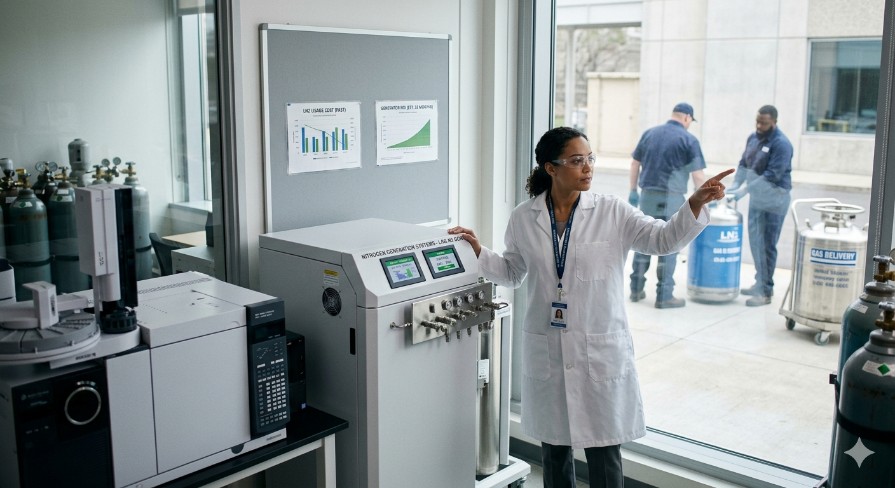
Nitrogen Generator ROI: Eliminating Liquid Gas Deliveries in Labs
Imagine it is 4:00 PM on a Friday. Your lab is racing to complete a critical GC-MS batch before the weekend, and suddenly the nitrogen cylinder hits empty. The backup cylinder has insufficient pressure, the supplier’s emergency line is busy, and your team faces costly downtime or compromised samples. This scenario plays out in research facilities across the country because, according to a recent survey of 78 U.S. lab professionals, 59% still rely on nitrogen cylinders for daily operations despite rising supply chain vulnerabilities. If you are managing laboratory operations or procurement, you have likely wrestled with rental fees, delivery delays, and the hidden labor costs of cylinder changeouts. This post will walk you through exactly how on-site nitrogen generation works, the true cost of delivered gas, and a framework for calculating when a nitrogen generator delivers measurable ROI for your facility.
What Is a Nitrogen Generator and How Does It Work?
A nitrogen generator is a system that separates nitrogen from ambient air and delivers it at a specified purity, pressure, and flow rate using compressed air as its feedstock. Unlike delivered nitrogen—which arrives at your facility via cylinders, dewars, or bulk liquid tankers that require handling, storage, and inventory tracking—on-site nitrogen generation produces gas continuously at the point of use. This shift from external supply to on-site production eliminates the logistical burden of coordinating deliveries and managing cylinder banks, while providing immediate access to the gas volumes your instruments demand.
The Science of Separating Nitrogen from Ambient Air
The feasibility of on-site generation rests on the consistent composition of Earth’s atmosphere. According to NOAA JetStream data, dry ambient air contains approximately 78.084% nitrogen and 20.946% oxygen by volume, with trace amounts of argon, carbon dioxide, and other gases. Because nitrogen constitutes over three-quarters of the air we breathe, gas generation systems can use mechanical separation rather than chemical synthesis to isolate this abundant resource. You simply need a reliable compressed air feed and a separation technology that exploits the physical differences between nitrogen and oxygen molecules.
PSA vs. Membrane Separation Mechanisms
Two primary technologies dominate the industrial nitrogen market: Pressure Swing Adsorption (PSA) and membrane separation. PSA systems utilize carbon molecular sieve (CMS) media housed in paired adsorption chambers. Compressed air enters one vessel where oxygen molecules adsorb onto the CMS surface under pressure, allowing nitrogen to pass through as product gas. While one chamber undergoes adsorption, the other undergoes regeneration at lower pressure, releasing the captured oxygen back into the atmosphere. This pressure swing between chambers creates a continuous flow of nitrogen. In contrast, membrane generators employ hollow polymer fibers. When dry, clean compressed air flows through these fibers, oxygen, water vapor, and argon permeate through the membrane walls faster than nitrogen, which travels through the fiber bore as the product gas. PSA systems typically achieve higher purity levels suitable for sensitive analytical instruments, while membrane systems offer simplicity and fewer moving parts for applications requiring moderate purity.
The Hidden Costs of Relying on Cylinder Deliveries in USA Labs
Despite the availability of generation technology, liquid gas delivery remains the default for nearly six in ten American laboratories. This dependence creates significant operational vulnerabilities. Delivery delays caused by weather, driver shortages, or supply chain disruptions can halt critical analyses for hours or days. You also face ongoing rental fees for cylinder banks, monthly hazmat surcharges, and administrative labor devoted to inventory tracking and order reconciliation. Each cylinder changeout consumes valuable technician time—time not spent on actual research or analysis. Additionally, returned cylinders typically contain residual gas under pressure that cannot be extracted, meaning you pay for nitrogen you never use. When deliveries fail entirely, the business continuity risks extend beyond inconvenience to potential sample loss and missed regulatory deadlines. On-site generation removes these variables, delivering a reliable stream of industrial nitrogen independent of trucking schedules or third-party availability.
Calculating Lab ROI: Factors Beyond Equipment Cost
Determining whether a nitrogen generator makes financial sense requires looking past the capital equipment price tag to your total cost of supply. Direct costs include cylinder purchase or rental fees, per-delivery truck charges, and hazardous materials handling fees. However, the indirect costs often dwarf these line items: technician labor for constant cylinder changeouts, production downtime when supplies run low, wasted gas from residual pressure, and potential costs associated with accidents or injuries during cylinder handling. According to ROI frameworks from industry authorities, a comprehensive calculation should incorporate every cost factor from delivery logistics to safety incident preparedness.
The True Cost of Delivered Nitrogen Supply
When you return a “empty” cylinder to your supplier, a significant volume of gas remains trapped at low pressure—gas you purchased but cannot access. You also absorb administrative overhead for tracking cylinder inventory, coordinating delivery windows, and managing safety documentation. Delivery truck surcharges for after-hours or rush orders add further unpredictability to your laboratory nitrogen supply budget.
Sample ROI Calculation Structure for High-Usage Labs
Consider a high-throughput analytical lab consuming the equivalent of 25-30 high-pressure nitrogen cylinders per month (approximately 75 CCF). For a lab with this level of sustained usage, ROI payback periods for a nitrogen generator typically fall within the 18-36 month range. For facilities with much higher, industrial-scale consumption, payback periods can be even shorter, with some documented cases under 17 months. Your specific results will vary based on local electricity rates, compressor efficiency, and exact consumption patterns, but the framework remains consistent: sum all current supply costs, subtract projected electricity and maintenance for the generator, and divide by the equipment investment to determine your lab ROI timeline.
PSA vs. Membrane: Choosing Industrial Nitrogen Systems for Laboratory Use
Selecting between PSA and membrane technologies depends heavily on your analytical requirements. PSA systems utilizing carbon molecular sieve media excel at producing higher purity nitrogen—often exceeding 99.9%—making them essential for sensitive instruments like LC-MS, GC-MS, and ICP spectrometers that demand ultra-high purity carrier gases. Membrane systems provide a simpler mechanical pathway suitable for applications requiring 95-99% purity, such as sample evaporation or instrument purging, with typically lower energy consumption and minimal maintenance schedules. Both PSA and membrane gas generation systems require a dry, clean, oil-free compressed air feedstock; contamination from moisture, particulates, or oil will degrade performance and can permanently damage the separation media in either technology. Your final selection should balance purity requirements against flow rate demands, energy costs, and maintenance capabilities.
Safety and Facility Requirements for On-Site Nitrogen Generation in the USA
Implementing on-site nitrogen generation in the United States requires careful attention to OSHA safety standards, particularly regarding oxygen-deficient atmospheres. The agency defines an oxygen-deficient atmosphere as one containing less than 19.5% oxygen by volume, while oxygen-enriched atmospheres exceed 23.5%. Because nitrogen displacement during inerting operations creates Immediately Dangerous to Life or Health (IDLH) conditions through oxygen depletion, you must install proper ventilation and oxygen monitoring systems in any enclosure where nitrogen accumulates. Facility requirements extend to your compressed air infrastructure; both PSA and membrane generators demand dry, oil-free feed air, which may necessitate upgrading existing lab air systems or installing dedicated compressors with appropriate filtration and drying stages. Space considerations include not only the generator footprint but also heat dissipation and noise management for adjacent workspaces.
OSHA Compliance and Oxygen Monitoring
Any laboratory using nitrogen for inerting applications must monitor oxygen levels continuously in enclosed areas. The 19.5% oxygen deficiency threshold represents the critical safety limit; falling below this concentration creates asphyxiation hazards for personnel. Install fixed oxygen monitors with audible alarms in areas where nitrogen generators operate, and establish protocols for immediate evacuation and ventilation if alarms trigger.
Compressed Air Quality and Infrastructure Needs
Both generation technologies require dry, clean, oil-free compressed air to function effectively and protect sensitive membranes or molecular sieves from contamination. Evaluate whether your existing facility air system can provide oil-free Class 0 compressed air, or if you need a dedicated compressor installation with integrated dryers and filtration. This infrastructure decision significantly impacts both upfront capital costs and long-term maintenance requirements.
Implementation Roadmap: From Assessment to Validation
Transitioning from delivered cylinders to on-site generation follows a structured pathway. Begin with a thorough assessment of your actual flow rates and purity requirements by instrument type—different analytical platforms demand different nitrogen specifications. Next, select your technology: PSA for high-purity analytical applications, membrane for moderate-purity operations. Evaluate procurement models including direct capital purchase, operational leases, or comprehensive service contracts that bundle maintenance and replacement parts; each approach affects cash flow and total cost of ownership differently. Plan installation logistics carefully, accounting for generator noise levels, heat output, and ventilation requirements in your mechanical room or lab space. For regulated environments, institute validation protocols demonstrating consistent purity output and pressure stability. Establish proactive maintenance schedules covering filter replacements, dryer media checks, and oxygen analyzer calibration. Finally, implement a backup strategy—maintaining a small cylinder reserve for critical applications ensures continuity during generator maintenance or unexpected power events.
Procurement Models and Change Control
Capital purchase places full ownership and maintenance responsibility on your facility but offers the lowest long-term cost. Leasing spreads payments over time while preserving cash flow for other investments. Service contracts transfer operational risk to the vendor, bundling preventive maintenance and repairs into predictable monthly fees. Consider your internal technical capabilities and budget cycles when selecting the optimal financial structure for cost reduction lab operations.
Conclusion: Is On-Site Nitrogen Generation Right for Your Lab?
The decision to switch from liquid gas delivery to on-site generation hinges on three factors: volume, reliability, and safety preparedness. Labs with consistent, high-volume nitrogen needs (e.g., running multiple instruments daily) achieve the fastest nitrogen generator ROI, often seeing payback within a two-to-three-year timeframe. Facilities with histories of unreliable deliveries or remote locations gain immediate operational advantages from supply independence. However, safety planning is non-negotiable—you must address oxygen monitoring, ventilation, and staff training before commissioning any system. As you evaluate options, use this checklist: quantify your true total cost of cylinder supply, verify your compressed air infrastructure can support oil-free operation, select PSA or membrane based on instrument purity requirements, and plan for robust safety monitoring. For most modern laboratories, the combination of cost efficiency, supply reliability, and operational control makes on-site nitrogen generation a compelling alternative to traditional delivery models.